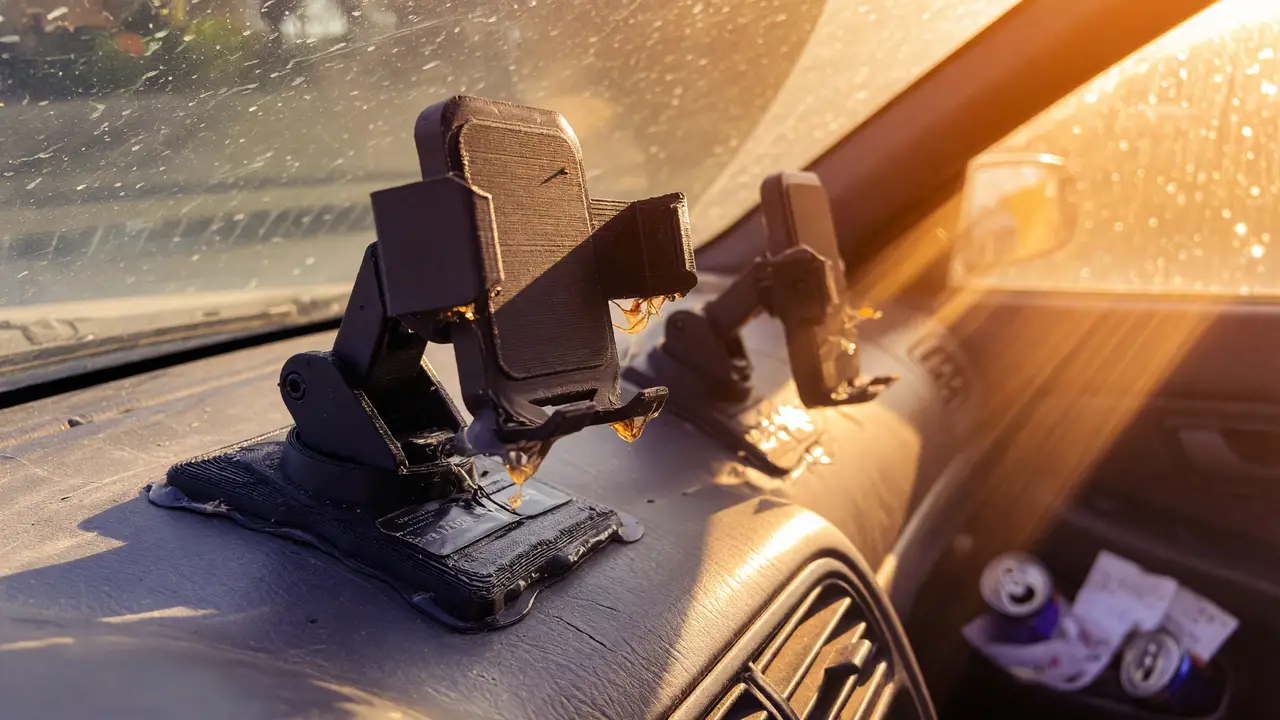
3D Printed Car Parts: Which Materials Can Withstand Summer Car Interior Heat?
Learn which 3D printing filaments survive extreme car cabin heat (up to 82°C). Full comparison of PLA, PETG, ABS and ASA with temperature data and recommendations.
Car interiors get brutally hot on sunny days. Leave a car outside when it’s 25 °C and the cabin can climb to 117–154 °F (47–68 °C) inside an hour. Dashboards and phone mounts often run hotter still, past 157–180 °F (69–82 °C). Most everyday filaments simply can’t take that kind of sustained heat, which is why material choice decides whether a printed part survives or sags.
Measured Cabin Temperatures vs. Filament Limits
Real-world automotive studies show the same numbers repeatedly. Dashboard surfaces regularly hit 69–71 °C, and dark trim can push past 82 °C. Even on a mild 20 °C day the cabin air reaches 48 °C after an hour and 60 °C after three. Those temperatures sit right at or above the heat-deflection point of most common filaments.
PLA – Predictable Failure
Standard PLA has an HDT around 55–58 °C and a glass-transition temperature near 60 °C. Once a loaded part crosses that line it softens and sags. Owners in Phoenix and Texas routinely watch phone mounts deform in under 90 minutes on 35 °C days. Even “high-temperature” PLA blends top out around 61 °C straight off the printer. Annealing improves things a little, but the results stay unreliable for anything that has to stay put.
PETG – Marginal at Best
PETG lists an HDT of 68–70 °C, yet creep often begins earlier under constant load. Dashboard clips and vent mounts printed in PETG warp after repeated heat cycles in hot climates. It works fine for shaded console or trunk parts in milder regions, but it’s not a safe choice for anything that sits in direct sun.
ABS and ASA – The Reliable Pair
ABS and ASA are the only materials that deliver consistent results:
- ABS: HDT 91 °C, Tg 100–110 °C
- ASA: HDT 88–100 °C, Tg 100–108 °C
Both stay rigid at the temperatures dashboards actually reach. ASA adds strong UV resistance, making it the clearer choice for visible trim or parts near windows. Forum reports from Prusa, QIDI, and Bambu Lab users confirm that properly printed ABS and ASA mounts survive repeated exposure to 90 °C surfaces without deforming.
Material Comparison
| Material | HDT (0.45 MPa) | Tg (°C) | UV Resistance | Recommended Use Case | Real-World Outcome |
|---|---|---|---|---|---|
| PLA | 55–58 °C | 60 | Poor | Prototypes only | Sags within hours |
| PETG | 68–70 °C | 80–85 | Moderate | Shaded/console parts | Creep common on dashboards |
| ABS | 91 °C | 100–110 | Moderate | Structural interior parts | Reliable up to 90+ °C |
| ASA | 88–100 °C | 100–108 | Excellent | Sun-exposed mounts and trim | Best long-term performer |
Decision Guide
flowchart TD
    A[Sun-exposed part?] -->|Yes| B[ASA or ABS]
    A -->|No| C[Shaded/console?]
    C -->|Yes| D[PETG acceptable]
    C -->|No| E[PLA only for prototypes]
    B --> F[Add annealing or glass-fill for extreme loads]
Practical Takeaways
- Print ASA or ABS with at least four perimeters and 40–50 % infill on load-bearing mounts.
- Orient parts so layer lines don’t run perpendicular to the main stress direction.
- Skip PLA and standard PETG for anything that lives in a parked car.
- Annealed high-temperature PLA or glass-filled ASA can work for niche high-load jobs, but they need extra steps.
Only ASA and ABS give you enough thermal margin for summer dashboard conditions. Pick one of those and your printed parts will stay functional instead of turning into expensive confetti.