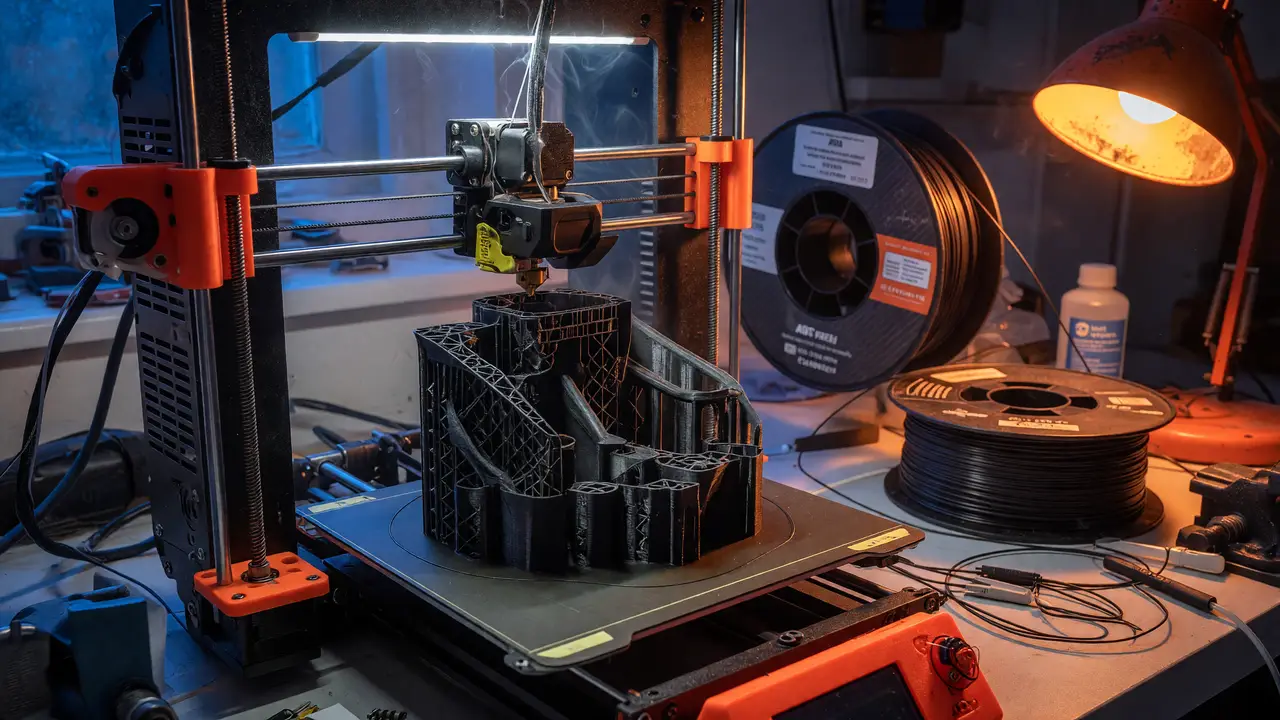
3D Printing with Engineering Materials: Guide for ABS, ASA, and Nylon (PA)
Compare ABS, ASA, and Nylon for functional 3D printing. Covers temperatures, enclosures, mechanical properties, pricing, warping fixes, and hardware setup.
Picking the right filament for functional prototypes usually boils down to one question: will the part hold up to real heat, impact, and whatever environment it ends up in? ABS, ASA, and Nylon can handle that kind of abuse, but each one needs its own hardware setup and handling—nothing like the simple PLA workflow most people start with.
Temperature and Enclosure Requirements
All three materials want a warm chamber. Without it, larger parts warp or split between layers.
- ABS runs best at 230–255 °C nozzle and 95–110 °C bed. Keep the chamber around 45–60 °C.
- ASA likes 255–265 °C nozzle and 90–110 °C bed. It can manage with a slightly cooler chamber (40–55 °C), but enclosure is still required for reliable results.
- Nylon prints at 240–270 °C nozzle and 70–110 °C bed. Some low-warp grades prefer bed temps under 50 °C. Chamber stability matters most.
Start with a passive enclosure and give the printer 10–15 minutes to warm up. Corner lift usually means you need either active heating or the cooling fan turned down to 0–20 %.
Mechanical Properties Comparison
Printed parts never match injection-molded numbers. Here’s what you can actually expect from FFF prints:
| Material | Tensile Strength | Impact Resistance | HDT @ 1.8 MPa | Notes |
|---|---|---|---|---|
| ABS | 35–45 MPa | Medium–High | 85–100 °C | Good all-rounder; edges Izod impact when dry |
| ASA | 37–50 MPa | Medium–High | 85–106 °C | Strength matches ABS, far better UV resistance |
| Nylon | 48–83 MPa | Very High | 110–175 °C | Strongest when dry; stiffness drops once it absorbs moisture |
Nylon wins on toughness and heat resistance if you keep it dry. ASA is the clear choice for anything that lives outdoors.
Current Pricing (2024–2026)
Prices below are for 1 kg spools and reflect both the material itself and the packaging it ships in.
- ABS: $14–30/kg (budget spools $14–22, Prusament around $25–30)
- ASA: $15–60/kg (budget options $15–20, Prusament closer to $56–60)
- Nylon: $40–95/kg (true engineering grades sit at the top end)
Expect to pay 20–50 % more for ASA than ABS if UV stability matters. Nylon pricing already factors in proper drying and vacuum-sealed bags.
Managing Warping and Moisture
Nylon is the most moisture-sensitive of the three. A few hours of exposure is enough to cause popping, stringing, and weak layers. Dry it at 60–80 °C for 4–12 hours, then print straight from a heated dry box. Vacuum-seal what’s left as soon as you’re done.
ABS and ASA mainly fight thermal gradients. The usual fixes work well: a brim or mouse ears, slow first-layer speed, clean PEI or glue-stick adhesion, and chamber air above 40 °C. Nylon’s moisture issues make warping worse, but with ABS and ASA the problem is almost always temperature.
Recommended Hardware Setup
You’ll need three things for consistent results:
- An enclosed CoreXY printer (Bambu Lab X1C/P1S or Prusa MK4S plus enclosure)
- A decent enclosure kit (Sovol Enclosure 2.0 or Creality kit, roughly $50–80)
- An active filament dryer (MatterHackers PrintDry PRO works well for Nylon)
A simple cardboard box can handle small ABS or ASA parts, but it won’t cut it for Nylon or anything bigger.
Here’s a typical workflow for getting reliable prints with these materials:
flowchart TD
    A[Material Selection] --> B{Is it Nylon?}
    B -->|Yes| C[Dry Filament 60-80°C 4-12h]
    B -->|No| D[Prepare Enclosure]
    C --> D
    D --> E[Warm Chamber 10-15 min]
    E --> F[Set Nozzle/Bed Temps]
    F --> G[Print with 0-20% Cooling]
    G --> H[Inspect for Warping]
Conclusion
ABS, ASA, and Nylon each solve different engineering problems once you match them with the right temperatures, enclosure, and drying routine. Choose the material based on what the part actually has to survive, then set the printer accordingly. You’ll end up with functional prototypes that behave a lot more like the final production parts.