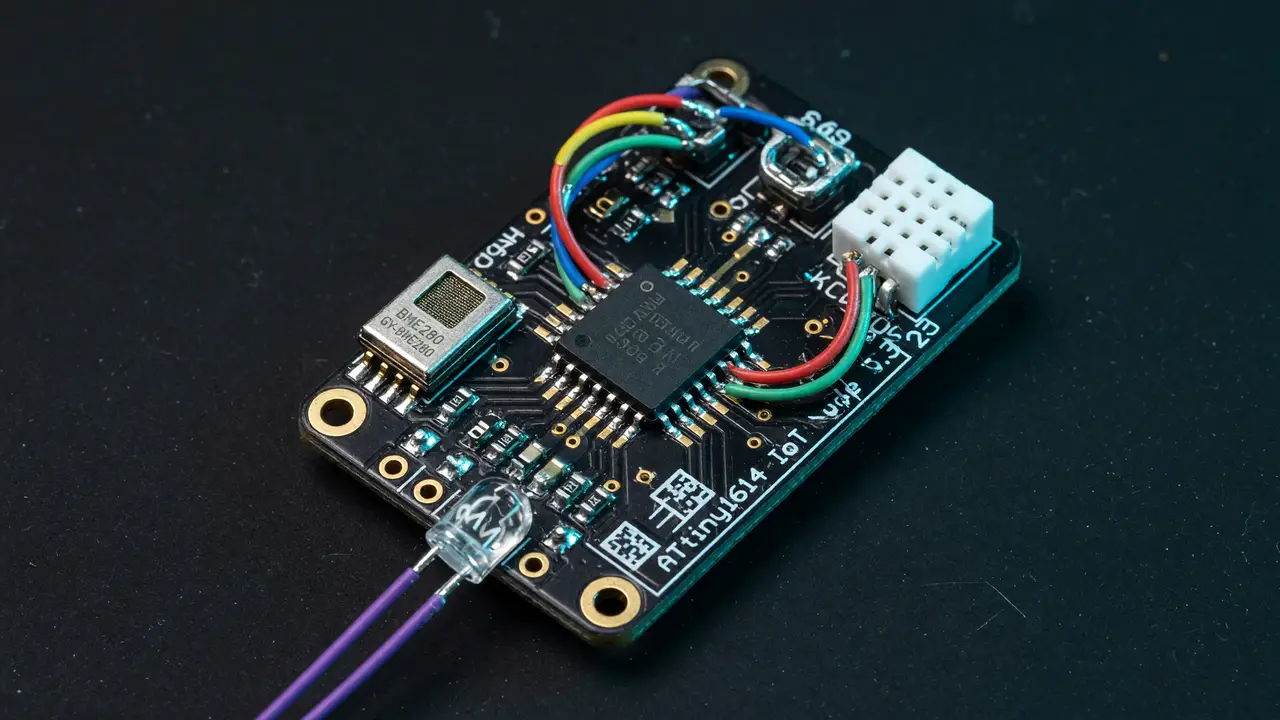
ATtiny1614: Why This Tiny Chip Is Perfect for Dedicated Sensor Nodes
Discover how the ATtiny1614 microcontroller excels in dedicated sensor nodes, offering ultra-low power consumption and versatile peripherals for year-long battery life.
When building a sensor node meant to run a year or more on a small battery, the microcontroller often makes or breaks the project. The ATtiny1614 manages this with 16 KB of Flash, a 0.1 µA power-down current, and a solid set of peripherals packed into a 14-pin chip.
Core Specifications
It uses an 8-bit AVR core that clocks up to 20 MHz and includes a hardware multiplier. Here’s the memory and I/O breakdown:
- 16 KB Flash, good for 10k write cycles
- 2 KB SRAM
- 256 bytes EEPROM, rated for 100k cycles
- 12 programmable I/O lines
The voltage range spans 1.8–5.5 V, and you get full speed above 4.5 V. An internal 16/20 MHz RC oscillator and a 32 kHz ULP RC let most projects skip external crystals. Everything programs through the single-wire UPDI interface, which simplifies the layout.
Power Consumption and Sleep Behavior
Active current runs about 0.2 mA at 1 MHz and 1.8 V. Drop into power-down and it falls to 0.1 µA at 1.8 V and 25 °C. Two features help turn these specs into long battery life:
- SleepWalking lets peripherals keep working while the CPU sleeps
- The Event System routes signals between peripherals without waking the core
A real under-bed PIR node measured 12 µA total sleep current with the MCU and one sensor, climbing to 22 µA with two sensors. On a 6 V pack at low duty cycle, that points to over 500 days of runtime.
Peripherals Optimized for Sensing
Two 10-bit ADCs (115 ksps, 14 channels combined), three 8-bit DACs, and three analog comparators sit on the chip. Other blocks that matter for sensor work include:
- 16-bit RTC with 32.768 kHz support
- Configurable Custom Logic (CCL) with two LUTs
- Peripheral Touch Controller for six self-capacitance channels
- USART, SPI, and I²C (Fast-mode Plus)
These let you handle ADC sampling, threshold checks, and capacitive wake-up in hardware before the CPU ever turns on.
flowchart TD
    A[Power-down] -->|RTC/Event| B[Sample ADC]
    B -->|Threshold met| C[Wake CPU]
    C --> D[Process & Transmit]
    D --> A
Comparison with Competing MCUs
The ATtiny1614 sits in a useful middle ground on package size, peripheral count, and price.
| MCU | Sleep Current | Active Current | Flash | Pins | 1k-unit Price (approx.) |
|---|---|---|---|---|---|
| ATtiny1614 | 0.1 µA | 0.2 mA @ 1 MHz | 16 KB | 14 | $0.65–0.90 |
| EFM8SB1 | 50–300 nA | 150 µA/MHz | 8–16 KB | 10–14 | $0.70–1.00 |
| STM32L011 | 0.3–1 µA | <100 µA/MHz | 16 KB | 14–20 | $1.00–1.50 |
| MSP430FR2xx | ~7–300 nA | ~100 µA/MHz | 16 KB | 14–20 | $0.80–1.20 |
It gives you dual ADCs and CCL at the smallest pin count while staying under a dollar in volume.
Documented Sensor-Node Results
Builders on forums have used the part with PIR sensors and seen the same 12–22 µA sleep numbers, translating to multi-year life on AA or 6 V packs. The same setup works for LoRa environmental nodes that hit 75 % Flash utilization and 14 months on 155 mAh cells at low duty cycles. Capacitive wake-up through the PTC also cuts down on external parts.
Practical Takeaways
- Pick the ATtiny1614 when you need more than 8 KB Flash but want to stay in a small package with low sleep current.
- Lean on the Event System and SleepWalking so the CPU stays off during routine sampling.
- Budget $0.65–0.90 per unit at 1 k volume; stock remains available from major distributors through 2025.
- Program with megaTinyCore over UPDI—no bootloader needed.
The ATtiny1614 is still an active, recommended part in Microchip’s lineup. For dedicated, long-life sensor nodes that must fit in tight spaces, it keeps offering the right mix of memory, peripherals, and power.