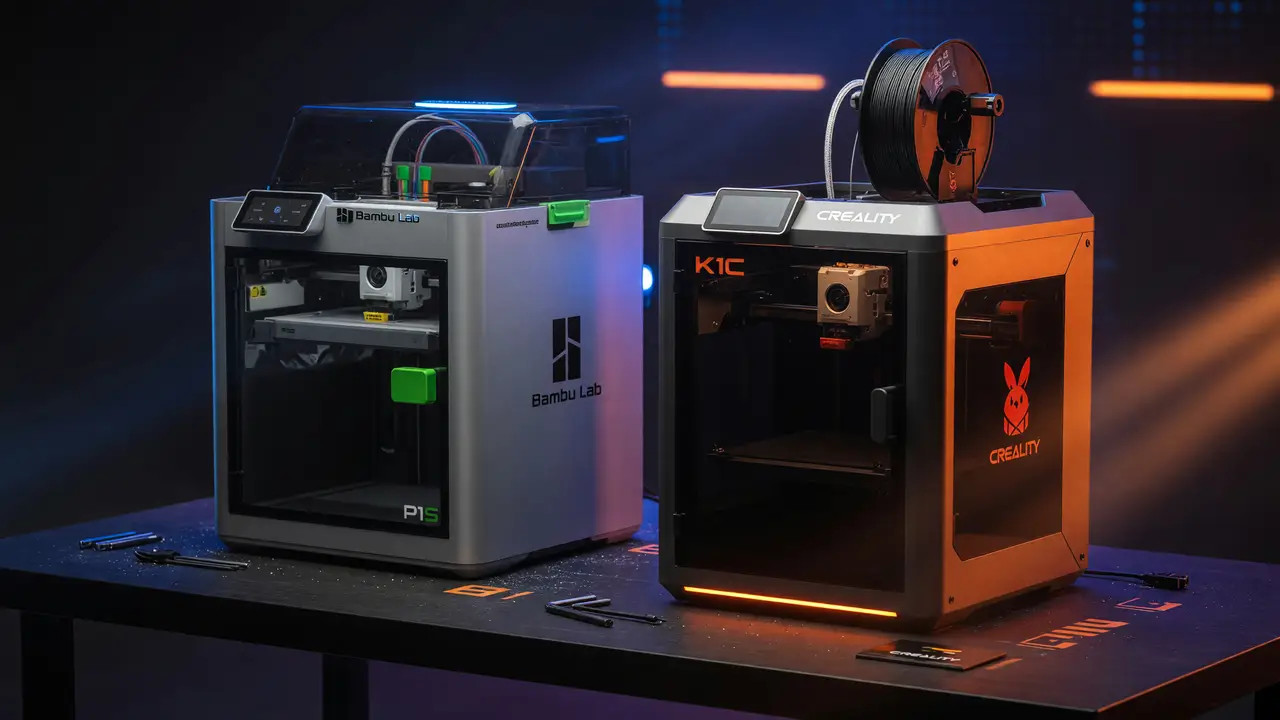
Bambu Lab P1S vs Creality K1C: Which CoreXY Printer Is Best in 2026?
Compare Bambu Lab P1S and Creality K1C CoreXY printers in 2026 on pricing, speed, build volume, materials, software, and reliability to decide the best option.
CoreXY printers advanced fast between 2023 and 2026. Two models from that wave—the Bambu Lab P1S and Creality K1C—still sit on shelves even as newer machines undercut them on price. Most buyers now face a straightforward trade-off: pay more for the P1S’s polish or save money with the K1C and its factory carbon-fiber support.
Pricing and Street Value
Street prices place the printers in separate ranges:
- Bambu Lab P1S: $549 (US), €499 (EU)
- Creality K1C: $369–559, frequently found near the bottom of that range
The P1S holds its original price and only dips during short promotions. The K1C benefits from frequent discounts and a 2025 refresh, making it the practical choice when upfront cost matters most.
Build Volume and Speed
Both target fast printing, yet their build volumes differ.
| Specification | Bambu Lab P1S | Creality K1C |
|---|---|---|
| Build volume | 256 × 256 × 256 mm | 220 × 220 × 250 mm |
| Max advertised speed | 500 mm/s | 600 mm/s |
| Typical sustained speed | ~300–400 mm/s | ~300 mm/s |
| Acceleration | 20 000 mm/s² | 20 000 mm/s² |
| Max flow | 32 mm³/s | 32 mm³/s |
The larger P1S volume suits single-piece functional parts. The K1C posts a higher peak speed on paper, but real-world throughput lands roughly the same once flow and cooling constraints appear.
Enclosure and Material Capability
Both arrive fully enclosed. The P1S uses plastic side panels, a glass door, an activated-carbon filter, and passive chamber heating. The K1C adds a polycarbonate-and-glass chamber, an air purifier, and a hardened-steel nozzle that handles carbon-fiber filaments from the start.
That stock nozzle gives the K1C an immediate advantage with abrasive composites. The P1S requires a swap to match it. Bed temperatures reach 100–120 °C on both, covering most engineering filaments with the chamber closed.
Software and Workflow
Bambu Lab’s software stack creates the clearest practical difference. Bambu Studio and the Handy app manage slicing, multi-color AMS control, and remote monitoring with almost no extra setup. Creality’s tools improved with 2026 firmware, yet many users still perform extra mesh tuning and occasional extruder calibration.
The workflow gap looks like this:
flowchart TD
    Model[3D Model Import] --> Choice{Choose Printer}
    Choice -->|P1S| Bambu[Bambu Studio]
    Bambu --> SliceB[Slice & Send]
    SliceB --> Monitor[Remote Monitor via App]
    Monitor --> PrintB[Start Print]

    Choice -->|K1C| Creality[Creality Print / Orca]
    Creality --> Tune[Manual Mesh & Flow Tuning]
    Tune --> SliceC[Slice & Transfer]
    SliceC --> PrintC[Start Print]
The P1S fits users who want prints to begin with little friction. The K1C suits those willing to handle occasional mechanical tweaks for lower cost and built-in composite support.
Reliability and Long-Term Support
Owner reports from 2025–2026 show a steady pattern:
- P1S: Strong out-of-box consistency, fewer reports of X-axis binding or bed-leveling problems, and continued firmware updates after the P1P reached end-of-life in February 2026.
- K1C: Occasional X-axis binding or lubrication issues plus more variable first-layer results, balanced by easy spare-parts access and an active community sharing fixes.
Neither machine runs completely hands-off for every owner, but the P1S generally requires less initial attention.
Decision Factors in 2026
Newer machines such as the Elegoo Centauri Carbon (~$299) and Bambu’s P2S now sit alongside these two. The P1S and K1C remain relevant only when specific priorities align.
- Pick the P1S when build volume, software reliability, and fewer troubleshooting hours outweigh the $150–200 premium.
- Pick the K1C when carbon-fiber printing appears regularly, budget is limited, and occasional mechanical adjustments are acceptable.
Both still receive firmware updates in 2026, so long-term support does not yet separate them. The better choice rests on whether your workflow values immediate consistency or accepts some tuning time in exchange for lower cost and composite-ready hardware.