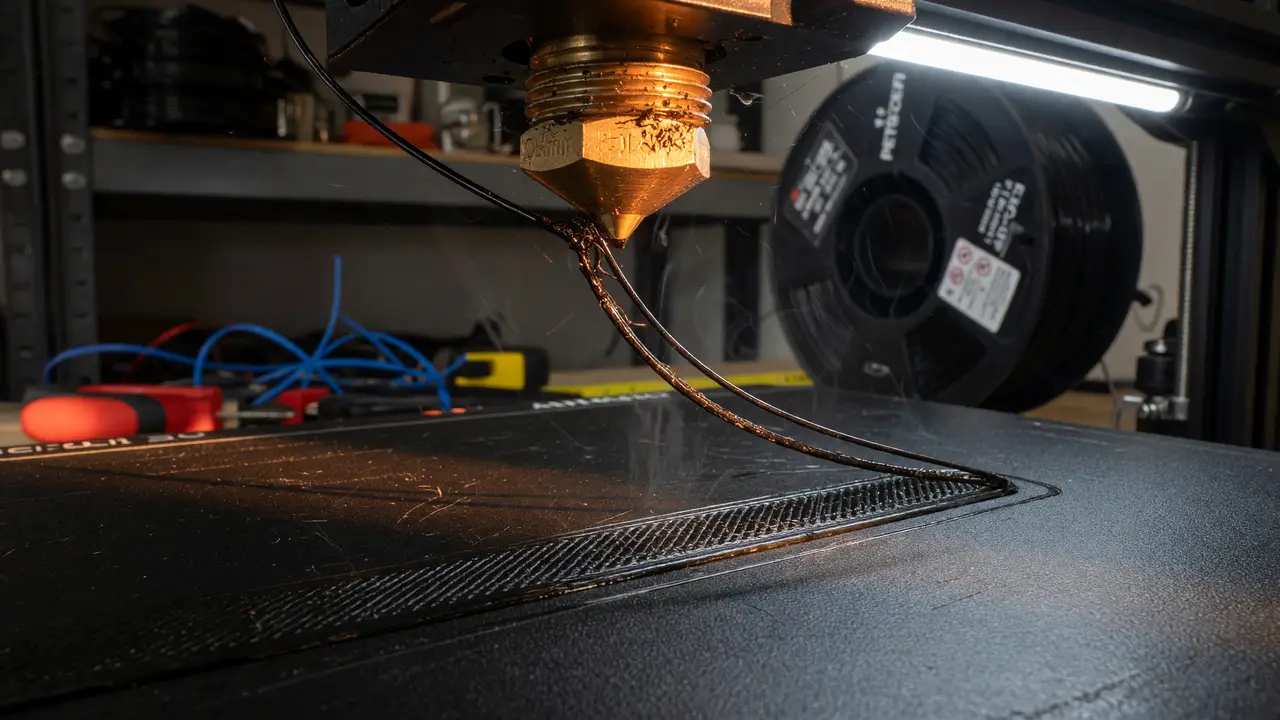
Best Settings for Carbon Fiber Reinforced Filament (PETG-CF)
Optimize PETG-CF prints with proven nozzle temps, speeds, retraction, drying, and hardened nozzles to prevent clogs and achieve strong, stiff parts.
PETG-CF combines the impact resistance of regular PETG with added stiffness and stability from the carbon fiber. Stock PETG profiles often cause clogs, weak layer adhesion, and stringing, but a handful of targeted changes to temperature, speed, and hardware resolve those problems.
Carbon Fiber Content and Its Practical Impact
Most commercial PETG-CF filaments contain 8–20 wt% carbon fiber. At the low end (8–10 %), stiffness improves noticeably with only modest nozzle wear. Move into the 15–17 % range and parts grow significantly more rigid, though the risk of clogs rises and larger nozzles become necessary. Polymaker’s Fiberon PETG-rCF08 uses 8 % recycled fiber, while its PET-CF17 reaches 17 %. Bambu Lab and Prusament typically sit in the 10–15 % bracket. Higher fiber loads suit functional parts well, as long as you run a hardened nozzle and slow perimeter speeds for solid interlayer bonding.
Manufacturer-Recommended Settings Comparison
Official data sheets differ on bed temperature and speed. Here’s a quick comparison of the three most common brands:
| Brand | Nozzle Temp | Bed Temp | Max Speed | Retraction (Direct Drive) | Surface Recommendation |
|---|---|---|---|---|---|
| Polymaker | 240–260 °C | 60–70 °C | 300 mm/s | 1 mm @ 20 mm/s | Textured PEI or PC |
| Prusament | 255–275 °C | 80–100 °C | 200 mm/s | Not specified | Powder-coated or satin sheet |
| Bambu Lab | 240–260 °C | 70–90 °C | 200+ mm/s | 0.8–1.2 mm | Engineering plate |
These values come straight from each manufacturer’s technical documentation.
Community-Tested Optimal Parameters
Real-world reports from 2023–2024 point to tighter windows than the official ranges:
- Nozzle: 250–255 °C (roughly 5 °C above plain PETG helps wetting)
- Bed: 80 °C on textured PEI
- Speed: 30–80 mm/s for walls, 100–160 mm/s for infill
- Cooling: 20–40 % fan or off for outer perimeters
- Retraction: 0.8–1.5 mm at 20–30 mm/s on direct drive
Drying the filament at 65 °C for 6–8 h before printing removes most stringing and popping problems.
Essential Hardware and Preparation Steps
Carbon fiber is abrasive, so a hardened steel nozzle (0.5–0.6 mm) is essential—brass will wear out in hours. An enclosure held at 35–45 °C helps in cold rooms but isn’t required otherwise. Drying the spool matters most; moisture turns the fibers into tiny steam jets that leave voids and weak bonds.
Practical checklist:
- Install a hardened nozzle
- Dry filament 6–8 h at 65 °C
- Use textured PEI or powder-coated sheet
- Drop perimeter speed 20–30 % versus plain PETG
- Keep fan low on outer walls
High-Speed Printing Without Clogs
Polymaker lists 300 mm/s as possible, yet quality usually drops above 160 mm/s on perimeters once fiber content exceeds 10 %. Infill can run faster safely. Start with a 0.6 mm hardened nozzle, 255 °C nozzle, 80 °C bed, and change one variable at a time. Many users reach 120–150 mm/s overall with Bambu Lab and Polymaker spools once drying and retraction are sorted.
Key Takeaways
PETG-CF rewards basic preparation more than fancy profiles. Dry the filament, fit a hardened nozzle, and slow the walls compared with standard PETG. Use the brand-specific nozzle and bed temperatures above as starting points, then tweak retraction and cooling for your direct-drive or Bowden setup. With those adjustments the material produces stiff, functional parts without constant headaches.