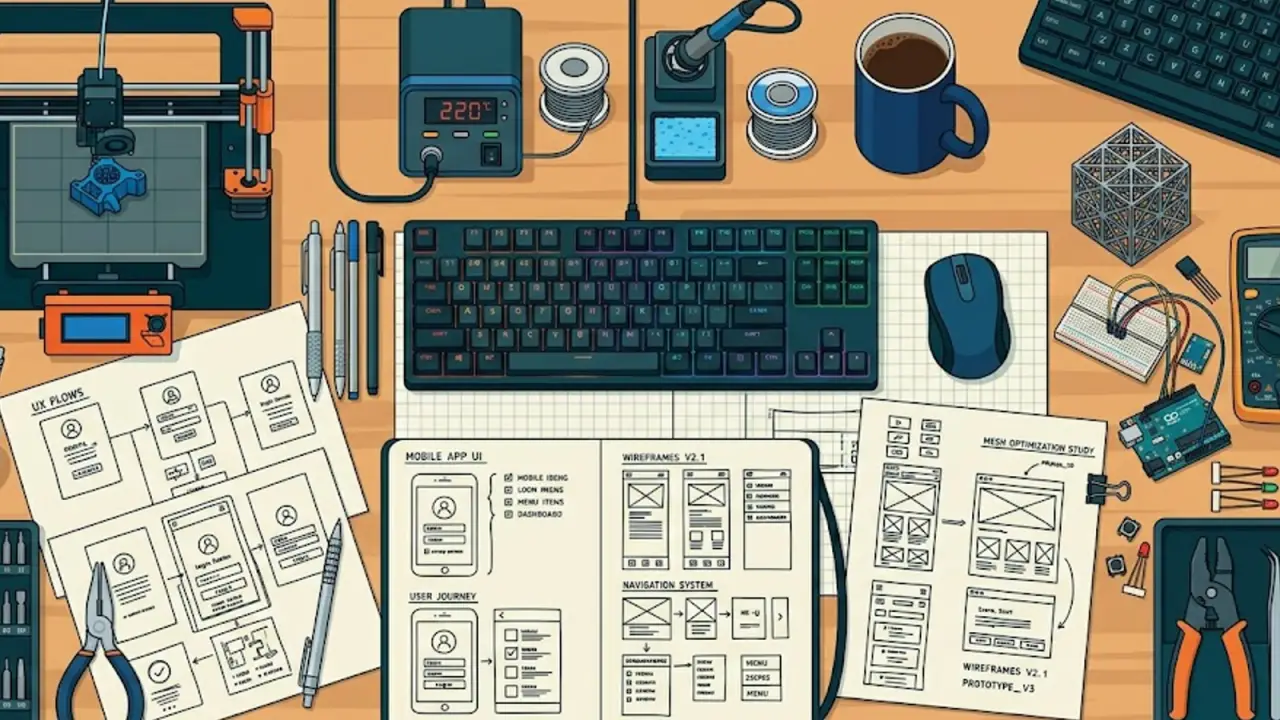
The 2026 DIY Engineering Gear Guide
A comprehensive shopping list for building a high-performance home lab capable of industrial-grade prototyping.
Building a functional engineering lab in 2026 is no longer about buying the cheapest tools available. It is about creating a cohesive ecosystem where your CAD designs, your 3D printer, and your bench tools communicate effectively. The goal is to reduce the time between ‘idea’ and ‘physical prototype’ while maintaining professional tolerances.
If you are setting up a workshop today, you need to prioritize precision and material versatility. The following categories represent the essential hardware stack for any serious maker looking to bridge the gap between hobbyist projects and retail-ready products.
The Motion System Core
The centerpiece of your lab should be a CoreXY 3D printer. In 2026, the industry has standardized on high-speed, enclosed machines that can handle engineering-grade filaments like ASA, Nylon-CF, and Polycarbonate.
- Bambu Lab X2D or Prusa Core One: These machines offer the reliability and speed required for functional parts.
- Active Filament Drying: A dedicated dryer like the Sunlu S4 is mandatory. High-performance filaments are extremely hygroscopic; printing with ‘wet’ nylon will ruin the structural integrity of your parts.
- Hardened Steel Nozzles: Standard brass nozzles will be destroyed within hours by carbon fiber reinforced materials. Always keep a 0.4mm and 0.6mm hardened set on hand.
Precision Bench Tools
Electronics integration is a core part of modern tinkering. You cannot rely on a basic hardware store soldering iron if you are working with SMD components or high-density sensor boards.
- Portable Smart Soldering: The Pinecil V3 or TS101 allows for precise temperature control via firmware, ensuring you do not lift pads on delicate PCBs.
- Digital Multimeter with Logging: Look for a unit with Bluetooth connectivity. Being able to log voltage drops over time on your phone is a game changer for troubleshooting battery-powered robotics.
- Desktop Fume Extraction: Health is often overlooked in DIY spaces. A HEPA-rated extractor is essential when soldering or vapor-smoothing prints to keep microplastics and VOCs out of your lungs.
Prototyping Consumables
Your ‘inventory’ is as important as your tools. I recommend keeping a curated stock of mechanical fasteners and specialized materials so that your workflow is never interrupted by a trip to the store.
- M3 Hex Fastener Kits: The gold standard for 3D printed assemblies. Standardizing on M3 allows you to design universal mounting points across all your projects.
- Heat-Set Inserts: Never screw directly into plastic if the part needs to be disassembled. Brass heat-set inserts provide a permanent, threaded metal hole in your 3D prints.
- Engineering Filaments: Beyond standard PLA, keep a roll of PA6-CF (Carbon Fiber Nylon) for structural parts and TPU (95A) for gaskets and impact protection.
The Digital Workflow
The bridge between your tools is your workstation. In 2026, the integration of AI-assisted CAD tools means you need a machine capable of handling generative design algorithms. A high-color-accuracy 4K monitor is no longer a luxury; it is necessary for spotting clearance issues in complex assemblies before you waste 20 hours on a failed print. Focus on a workspace that allows for quick transitions between your keyboard and your physical workbench.