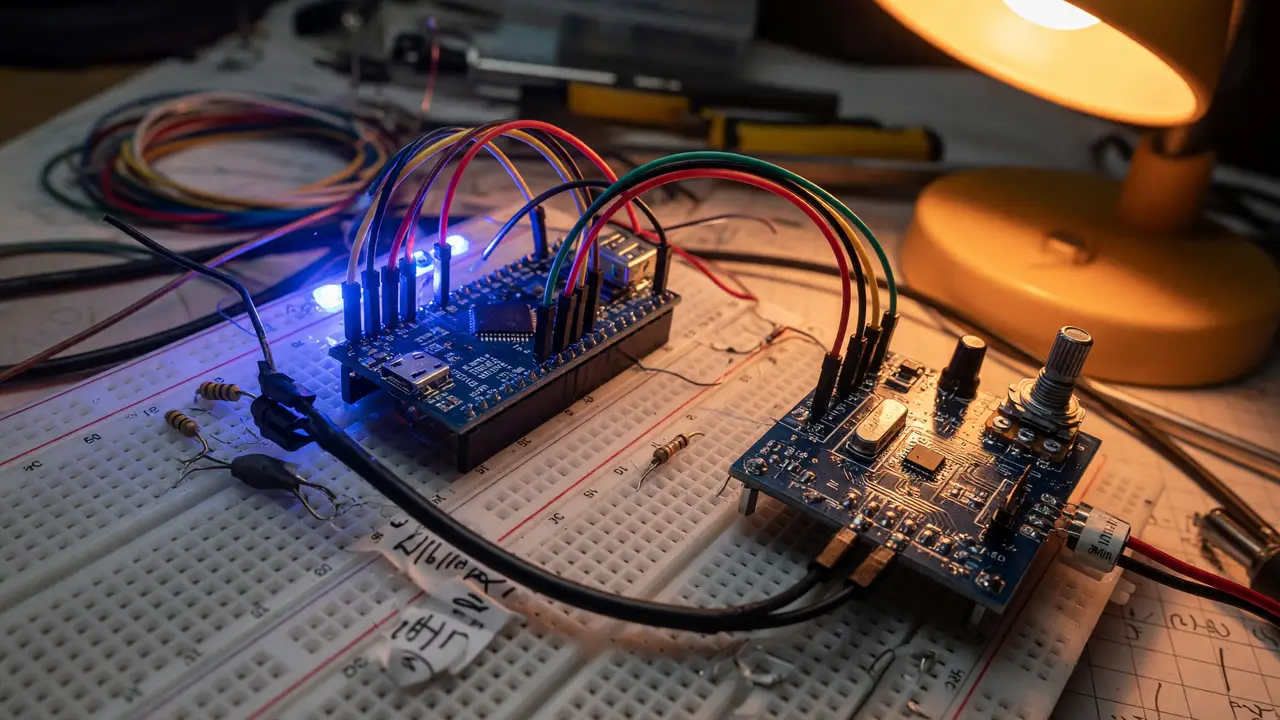
How to Digitally Control Analog Audio Amplifiers via Microcontrollers
Use digital attenuators like the PGA2311 and MCP41HV51 with microcontrollers for precise, low-distortion volume control while preserving analog audio performance.
Analog audio paths still deliver the lowest noise floors and most transparent signal handling in many designs. Builders who need remote, preset, or automated volume control don’t have to abandon the analog chain. A digitally addressed attenuator inserted in the right spot preserves dynamic range and avoids zipper noise.
The Core Tension
Traditional potentiometers wear out and lack repeatability. Simple digital potentiometers often add distortion or restrict headroom. Specialized volume-control ICs solve the problem with 256-step resolution, zero-crossing detection, and support for high-voltage analog rails. Two parts show up often in recent projects: the Texas Instruments PGA2311 and the Microchip MCP41HV51.
PGA2311 Specifications and Pricing
The PGA2311 gives two independent stereo channels with gain from +31.5 dB to −95.5 dB in 0.5 dB steps. The A-grade version reaches 120 dB dynamic range and 0.0002 % THD+N at 1 kHz while driving 660 Ω loads directly. It uses a simple 3-wire SPI bus that supports daisy-chaining, plus a dedicated mute pin and zero-crossing detector to keep clicks out of the audio.
Current single-unit pricing from Mouser:
- PGA2311UA (SOIC, A-grade): $13.37
- PGA2311U (SOIC): $9.97–11.77
- PGA2311PA/PDIP variants: $11.31–13.08
Stock remains solid at both major distributors.
High-Voltage Alternative: MCP41HV51
When your signal levels exceed the PGA2311’s ±5 V rails, the MCP41HV51 becomes useful. This 8-bit, 256-tap device accepts analog supplies from 10 V to 36 V (or ±5 V to ±18 V) while its digital side runs on 1.8–5.5 V. Typical wiper resistance is 75 Ω, and the WLAT pin lets you time updates to zero crossings. The 5 kΩ version reaches roughly 500 kHz bandwidth.
Comparison of Leading Digital Volume ICs
| Device | Analog Supply | Step Size | THD+N (typ.) | Key Strength | Approx. Price (1 pc) |
|---|---|---|---|---|---|
| TI PGA2311 | ±5 V | 0.5 dB | 0.0002 % | 120 dB dynamic range, zero-cross | $10–13 |
| TI PGA2310 | ±15 V | 0.5 dB | 0.0004 % | Higher headroom (27 Vpp) | $12–15 |
| Microchip MCP41HV51 | 10–36 V | 8-bit | ~0.01 % | High-voltage line-level use | $2–4 |
| NJM MUSES 72320 | ±15 V | 0.5 dB | <0.0005 % | Audiophile transparency | $25–35 |
ESP32 Integration Example
Hook the PGA2311 to an ESP32 on the usual SPI pins (MOSI, SCLK, CS). Enable zero-crossing detection by writing the right control byte after each volume change.
#include <SPI.h>
const int CS_PIN = 5;

void setVolume(uint8_t left, uint8_t right) {
  SPI.beginTransaction(SPISettings(1000000, MSBFIRST, SPI_MODE1));
  digitalWrite(CS_PIN, LOW);
  SPI.transfer(left);
  SPI.transfer(right);
  digitalWrite(CS_PIN, HIGH);
  SPI.endTransaction();
}
Power sequencing matters: bring up the analog ±5 V rails before the digital 5 V supply to avoid latch-up. Many builders add a simple MOSFET sequencer or just rely on the ESP32’s 3.3 V regulator startup timing.
Practical Takeaways
- Use the PGA2311 when you need measured 120 dB dynamic range and 0.5 dB steps at line level.
- Choose the MCP41HV51 for higher-voltage pro-audio paths or when cost matters most.
- Always enable zero-crossing or WLAT latching; turning these features off is the fastest way to get audible clicks.
- Check grounding and decoupling—poor layout will erase the low-distortion performance these chips are capable of.
Pick the right attenuator and handle power sequencing carefully. Digital control of analog audio becomes straightforward while keeping the signal path clean.