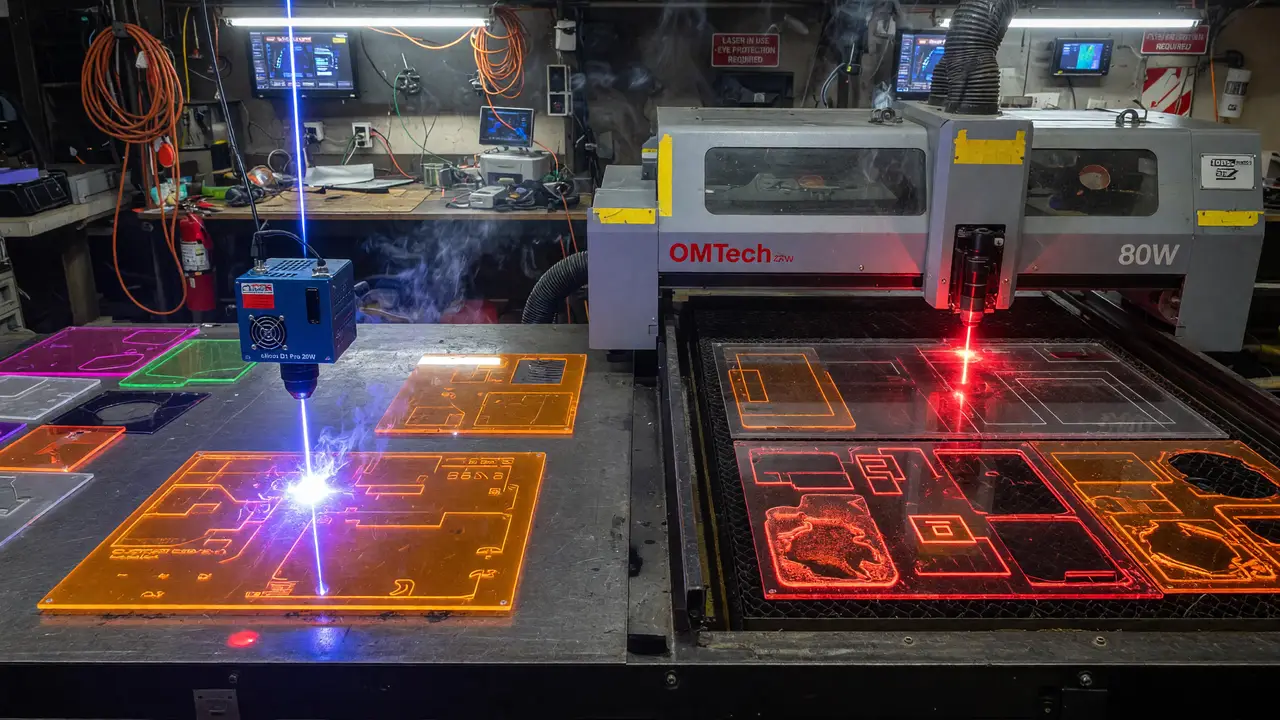
Diode vs CO₂ Lasers: Which Engraver/Cutter Should You Buy for Custom Acrylic Cases?
Compare diode and CO₂ lasers for cutting acrylic. Find out which machine delivers clean results for custom cases and when each type makes sense.
Choosing between diode and CO₂ lasers for cutting custom acrylic cases depends on how each wavelength interacts with the material. Diode machines fit most hobby budgets, yet they struggle with clear acrylic—the very material many builders prefer.
Wavelengths and Acrylic Absorption
Wavelength determines whether the beam gets absorbed or passes through. Diode lasers operate around 445–450 nm. Clear PMMA transmits nearly all of that blue light, with absorption below 5%. Only dark or opaque sheets absorb enough energy to cut, and the process remains slow even then.
CO₂ lasers use 10.6 µm light. Acrylic’s C=O bonds absorb this far-infrared wavelength at 92–93% efficiency. A 30 W CO₂ beam cuts 3 mm cast acrylic at about 8 mm/s. That speed exceeds what comparable diode units can manage by more than thirty times.
Diode Laser Results on Acrylic
10–20 W diode machines handle thin opaque acrylic under the right conditions.
- xTool D1 Pro 20 W: Cuts 3 mm black acrylic at ~8 mm/s in one pass with air assist
- Ortur Laser Master 3 20 W: Processes 3–5 mm opaque stock in 1–3 passes at 200–600 mm/min
- Atomstack 20–33 W: Reports 4–8 mm dark acrylic, though multiple passes are typical
Clear acrylic remains impossible. Successful cuts often leave rough or melted edges that need sanding. Air assist helps, and cast sheet outperforms extruded.
CO₂ Laser Performance
Entry-level CO₂ machines deliver clean, single-pass cuts on both clear and colored acrylic.
- Glowforge 40–45 W: 3 mm cast acrylic at 50 mm/s, reliable up to 6 mm
- OMTech 40–55 W: Handles 6–10 mm in one pass at speeds up to 400 mm/s
- Thunder Laser 30–60 W: Cuts 8–20 mm on higher models, producing flame-polished edges
Most enclosure parts need no extra finishing. With 30–50 W tubes, these machines cut 1–6 mm stock at production speeds.
Price and Setup Comparison
| Category | Diode Examples | CO₂ Examples | Typical Price Gap |
|---|---|---|---|
| Entry machine | xTool D1 Pro 20 W, Ortur LM3 | OMTech 30–40 W, Glowforge Aura | 3–6× |
| Complete acrylic kit | $800–$1,400 (with air assist) | $2,000–$3,500 (with enclosure) | 2–4× |
| Ventilation needs | Minimal | Required exhaust system | CO₂ adds cost |
Diode systems provide a lower-risk entry when cutting mixed materials. CO₂ machines require proper venting and often a dedicated enclosure.
Edge Quality and Case Suitability
CO₂ cuts produce glossy, transparent edges straight from the bed—ideal for edge-lit panels or press-fit enclosures. Diode cuts on dark acrylic usually result in cloudy or charred surfaces that demand additional work.
Reports from users in 2025–2026 confirm the pattern: diode lasers suit thin opaque hobby parts, while CO₂ offers the only practical route for clear or professional-grade acrylic cases.
“For any project where the final part must be transparent or dimensionally precise, CO₂ is non-negotiable.” — MachinesForMakers user summary, 2025
Decision Framework
Clear or transparent acrylic?
├── Yes → CO₂ laser (30 W minimum)
└── No  → Diode acceptable for thin dark stock
          ↓
Production volume >10 parts/week?
├── Yes → CO₂ (speed + finish)
└── No  → Diode for cost savings
Budget builders working only with dark acrylic can begin with a 20 W diode and air assist. Those needing clear panels, polished edges, or consistent case production should consider a 30–45 W CO₂ system along with proper ventilation.
The physics stays the same. Machines matched to the material deliver reliable results.