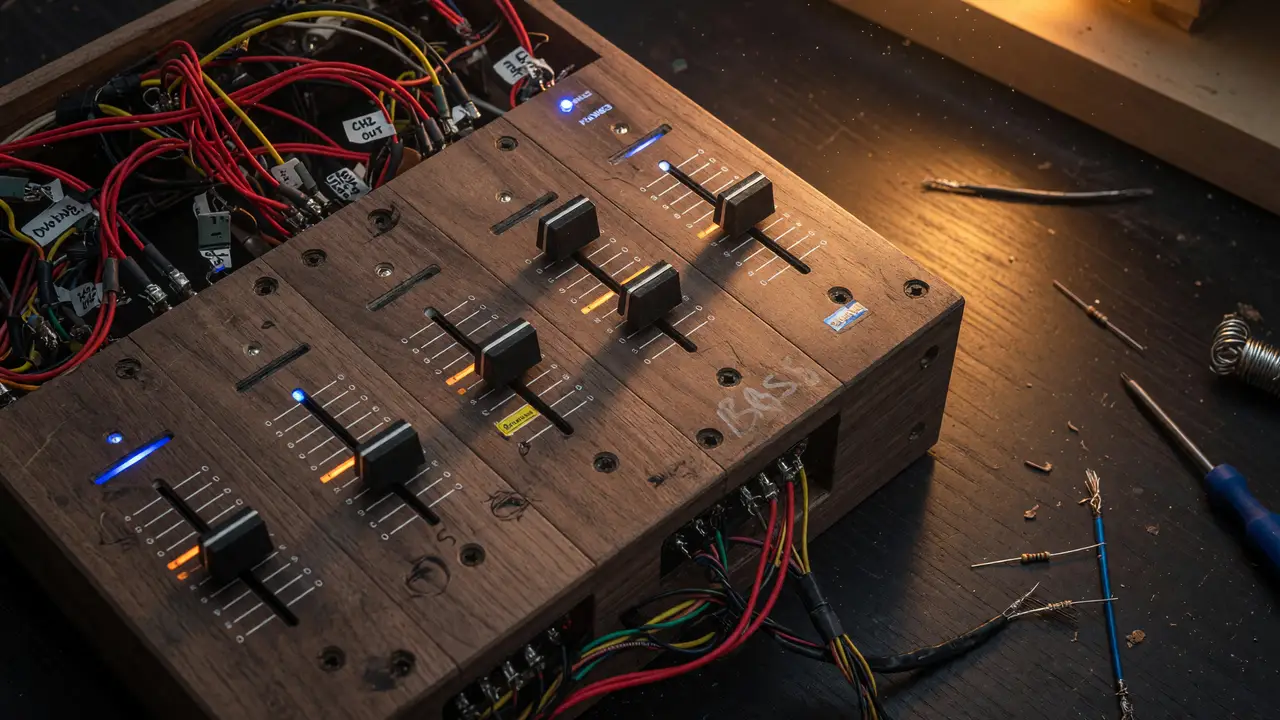
DIY MIDI Controller: Build a Custom DJ Mixer with Bourns Slide Faders
Build a custom DJ mixer with Bourns slide faders and Teensy for MIDI control. Affordable DIY solution with open-source code, schematics, and component comparisons.
Commercial DJ mixers lock you into fixed layouts and high prices. A custom build using Bourns slide potentiometers gives you the exact channel count, taper, and travel you need—at a fraction of the cost.
Bourns PTA and PTF series faders sit at the center of most reliable, low-cost MIDI builds. These carbon-track pots handle audio tapers, center detents, and travel lengths from 15 mm to 100 mm, with cycle ratings between 15 000 and 100 000.
Why Bourns PTA/PTF Faders Fit DJ Builds
Bourns models strike a practical balance of price, smoothness, and availability for multi-fader projects. The PTA6043-2015DPB103 (60 mm travel, 10 kΩ audio taper) typically lists for $1.83–$2.39 at Mouser and Farnell. Longer-travel PTF variants reach 100 mm and 100 k cycles while holding tracking error to ±2 dB.
Current specs for common models:
| Model | Travel | Resistance | Taper | Power | Life | Single-unit price |
|---|---|---|---|---|---|---|
| PTA1543-2015CPB502 | 15 mm | 10 kΩ | Audio | 0.1 W | 15 k | $1.60–$1.86 |
| PTA6043-2015DPB103 | 60 mm | 10 kΩ | Audio | 0.125 W | 15 k | $1.83–$2.39 |
| PTF (typical) | 45–100 mm | 10 kΩ | Linear/Audio | 0.125–0.5 W | 100 k | $3–$6 |
Those prices come from Bourns datasheets and distributor stock. At 5 k quantities, bulk pricing drops below $0.85 per unit.
Microcontroller Choices for MIDI Output
Native USB MIDI support removes extra drivers and latency. The Teensy 4.1 stands out for larger fader arrays: 600 MHz Cortex-M7, 18 analog inputs, and class-compliant MIDI across Mac, Windows, and Linux. It runs $29.95 at Adafruit.
The Arduino Leonardo offers a cheaper $10–$20 route with native HID/MIDIUSB, though it has fewer pins. ESP32 modules land around $5–$10 but need extra libraries to keep USB MIDI stable.
Open-Source Projects Worth Forking
Several repositories already include tested schematics and code. The Fader3 project pairs a Raspberry Pi Pico with an ADS1115 for three 100 mm linear faders and uses CircuitPython MIDI libraries. Traktorino shows 45 mm Bourns pots running through multiplexers on an Arduino Uno. ShlagMixer and mixduino demonstrate straightforward analog-to-MIDIUSB mapping on Leonardo-class boards.
Pick one repo, drop in your chosen Bourns models, and scale the analog pin count as needed.
Build Workflow Overview
flowchart TD
    A[Slide Faders] -->|Analog voltage| B[MCU Analog Pins]
    B --> C[Map 0-1023 to 0-127]
    C --> D[USB MIDI CC messages]
    D --> E[DAW / DJ software]
A minimal Teensy 4.1 sketch reads the faders and sends MIDI:
#include <MIDIUSB.h>

const int faderPins[] = {A0, A1, A2};
void loop() {
  for (int i = 0; i < 3; i++) {
    int val = analogRead(faderPins[i]);
    int cc = map(val, 0, 1023, 0, 127);
    usbMIDI.sendControlChange(1 + i, cc, 1);  // CC 1,2,3 on channel 1
  }
  delay(5);
}
Component Cost and Longevity Comparison
Bourns undercuts ALPS RK-series faders ($5+) while matching cycle life in most DIY builds. Panasonic EVJ parts offer sealed construction at similar prices but appear less often in public MIDI projects. A four-fader mixer keeps the Bourns BOM under $25 for the pots alone.
Practical Takeaways
- Match travel length to your enclosure depth—60 mm PTA models fit most desktop cases.
- Add dust covers or 3D-printed shrouds for heavy live use.
- Source caps from Thonk or Modular Addict for 8 mm shaft compatibility.
- Test taper response in software before final assembly—audio taper feels more natural for volume than linear.
A Teensy 4.1 plus four 60 mm Bourns faders produces a responsive, class-compliant DJ mixer for roughly one-tenth the price of an entry-level commercial unit. The same platform scales to eight or sixteen channels without touching the core firmware.