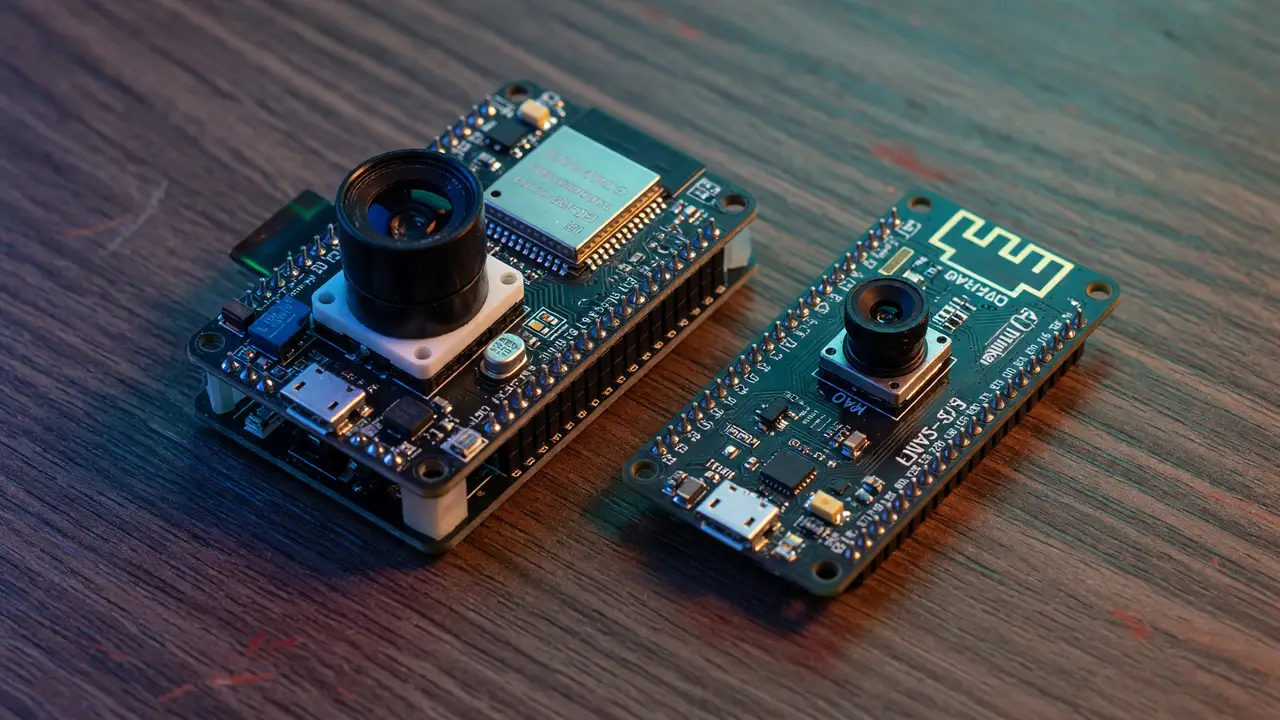
ESP32-CAM vs XIAO ESP32S3 Sense: Which Board Wins for Edge Vision on a Budget?
Compare ESP32-CAM and XIAO ESP32S3 Sense for edge vision on a budget. See specs, FPS, TinyML performance, power use, and which board fits your project.
The ESP32-CAM has handled cheap camera projects for years. Then the Seeed Studio XIAO ESP32S3 Sense arrived in 2023. The real question is when the newer board actually earns its higher price on edge-vision work.
Core Specs at a Glance
Both boards run dual-core 240 MHz ESP32 silicon and use the same OV2640 2 MP sensor. Memory and I/O are where they split.
| Feature | ESP32-CAM | XIAO ESP32S3 Sense |
|---|---|---|
| MCU | ESP32-D0WD (LX6) | ESP32-S3R8 (LX7 + AI extensions) |
| PSRAM | 4 MB | 8 MB |
| Flash | 4 MB | 8 MB |
| Dimensions | 40.5 × 27 mm | 21 × 17.8 mm |
| Camera FPS (QVGA) | ~12 (Wi-Fi stream) | ~50 local / 25 Wi-Fi |
| TinyML inference | ~525 ms (person detection) | ~317 ms |
| Deep sleep | ~6 mA | ~3 mA |
| Native USB | No | USB-C |
| microSD limit | 4 GB | 32 GB |
| Price (typical) | $2–$5 | $14–$18 |
Streaming and Local Capture Performance
The S3 Sense roughly doubles frame rate on the same sensor. Local QVGA capture hits 50 FPS, and sustained Wi-Fi MJPEG streaming holds 25 FPS while the ESP32-CAM tops out near 12 FPS. Higher resolutions stay limited by the radio on both boards, but the S3’s extra PSRAM and faster core keep things moving.
TinyML and Edge AI Workloads
Vector instructions and the larger PSRAM give clear gains. Person-detection models reach 3.5–4.3 FPS versus 2.1 FPS on the older board. Bigger networks like MobileNet or FOMO now run without constant memory swapping. The built-in digital microphone also lets you combine audio and video—something the ESP32-CAM needs extra hardware to do.
Power, Size, and Integration
At 21 × 17.8 mm the XIAO fits easily into wearables or small robots. It includes a LiPo charger and native USB-C, so you skip the FTDI adapter and external charging circuit the ESP32-CAM requires. Deep-sleep current falls to 3 mA, which helps battery life in always-on vision nodes.
Price and Project Fit
At $2–$5 the ESP32-CAM still makes sense for throwaway prototypes, classroom demos, or any project where every dollar counts. Once you need steady 20+ FPS streaming, larger models, or simpler wiring, the $14–$18 XIAO Sense repays the difference in time and headroom.
The S3 Sense is the board engineers reach for when the model no longer fits in the older ESP32-CAM’s memory budget.
Decision Guide
Use this quick checklist before ordering:
- Need sub-$5 BOM cost and simple still-image capture? → ESP32-CAM.
- Targeting 25 FPS streaming or MobileNet-class inference? → XIAO ESP32S3 Sense.
- Planning audio + vision fusion? → XIAO only.
- Shipping 100 units tomorrow? → ESP32-CAM.
Both boards use the same Arduino/ESP-IDF toolchain and Edge Impulse examples, so moving between them is straightforward once the older hardware becomes a limit.
The ESP32-CAM still sits at the bottom of the budget curve. For anything past basic MJPEG streaming or simple motion detection, the XIAO ESP32S3 Sense brings measurable improvements in speed, memory, and integration that justify the modest premium.