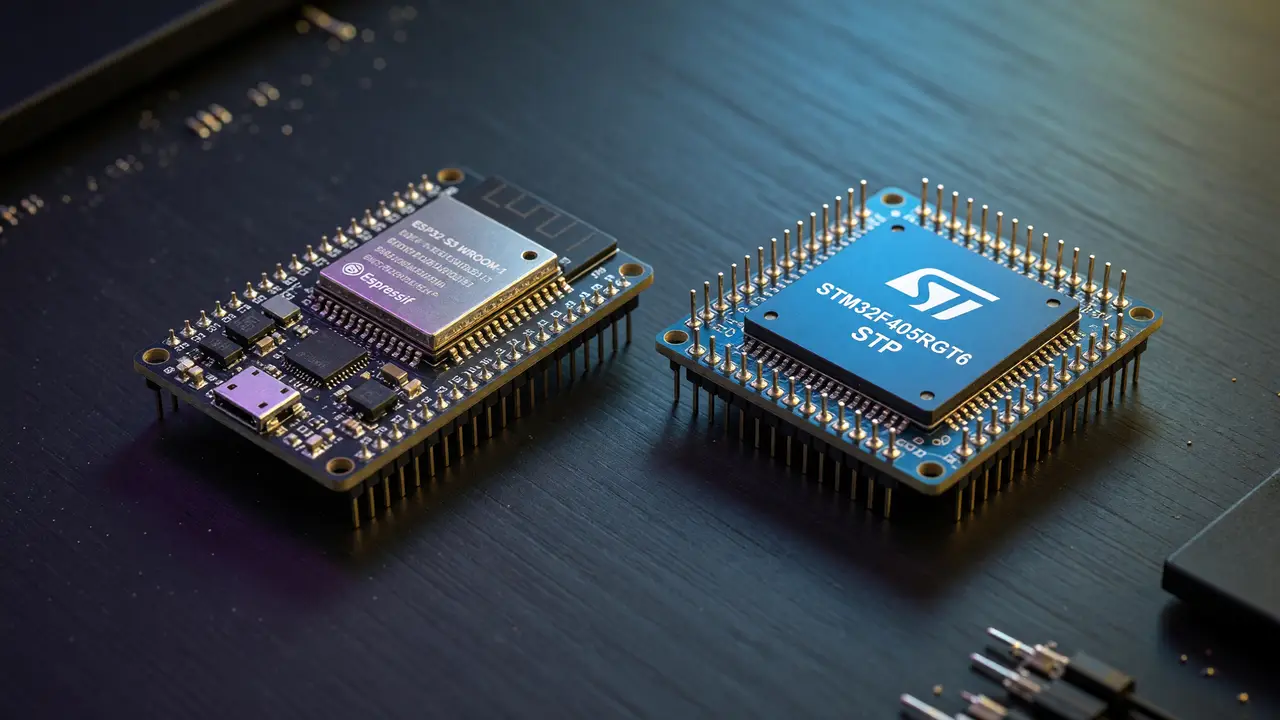
ESP32-S3 vs STM32: Which Microcontroller Should You Choose for Your Next Project?
Compare ESP32-S3 and STM32 microcontrollers: performance, wireless, power use, and dev tools to pick the right MCU for IoT or embedded projects.
The choice usually boils down to one question: do you need Wi-Fi and Bluetooth built in, or do you need rock-solid real-time behavior and years of industrial support?
Core Architecture and Performance
The ESP32-S3 runs a dual-core Xtensa LX7 at 240 MHz. It includes a single-precision FPU plus vector instructions that help with simple edge-AI jobs, posting 1329.92 CoreMark at full speed. STM32F4 parts top out around 168–180 MHz on a Cortex-M4F (roughly 3.4 CoreMark/MHz), while the STM32H7 reaches 480–550 MHz on a Cortex-M7 and clears 3200 CoreMark overall.
Raw compute still favors the H7, but the ESP32-S3’s SIMD extensions give it an advantage in camera pipelines and lightweight neural-net inference. For motor control or tight timing loops, the STM32’s cache and double-precision FPU on the H7 series stay ahead.
Wireless Integration
Everything you need for 2.4 GHz Wi-Fi (802.11 b/g/n) and Bluetooth 5 LE with long-range mode sits on the ESP32-S3 die, along with up to +21 dBm output. Pre-certified modules spare you most of the RF testing. Only the STM32WB and WL families carry wireless on-chip; everything else needs an external radio.
If the project must talk to Wi-Fi or a phone app without extra hardware, the ESP32-S3 is the clear pick.
Power Consumption Realities
| Mode | ESP32-S3 | STM32L4/U5 (typical) | STM32H7 (typical) |
|---|---|---|---|
| Deep sleep | 7 µA | <0.3–1 µA | ~2–10 µA |
| Active (no radio) | ~40 mA @ 240 MHz | 4–15 mA | 50–100 mA |
| Wi-Fi TX peak | 100–240 mA | N/A | N/A |
The STM32L4/U5 series wins for coin-cell devices that must run for years. The ESP32-S3 becomes competitive once Wi-Fi or BLE stays active; its ULP RISC-V coprocessor can handle light sensor work at roughly 22 µA.
Development Workflow and Ecosystem
- ESP32-S3: ESP-IDF (CMake + FreeRTOS) or the Arduino-ESP32 core. PlatformIO and MicroPython are both solid. Plenty of Wi-Fi and MQTT examples exist.
- STM32: STM32CubeIDE with graphical pin configuration through CubeMX. The HAL/LL libraries and Zephyr support are strong. Professional debugging and long-term maintenance are better documented.
Makers usually reach a connected prototype faster on the ESP32-S3. Teams shipping industrial or safety-critical firmware tend to prefer the STM32 toolchain and its predictable behavior.
Pricing and Hardware Availability
| Board / Module | Typical Price (2024) | Notes |
|---|---|---|
| ESP32-S3 DevKitC-1 | $9–15 | Includes USB-C, pins, antenna |
| ESP32-S3 WROOM module | $5–8 | Bare module for custom boards |
| STM32 Nucleo-F4 / H7 | $15–40 | Includes ST-Link debugger |
| STM32WB55 wireless board | $30+ | Integrated BLE |
ESP32-S3 hardware stays cheaper for wireless projects. STM32 boards usually include better onboard debug hardware.
Decision Framework
flowchart TD
    A[Project needs Wi-Fi or BLE?] -->|Yes| B[Choose ESP32-S3]
    A -->|No| C[Need <1 µA sleep or motor control?]
    C -->|Yes| D[Choose STM32L4 or H7]
    C -->|No| E[Need fastest prototype?]
    E -->|Yes| B
    E -->|No| D
Start with the ESP32-S3 when connectivity matters and the power budget can handle occasional Wi-Fi bursts. Switch to an STM32H7 or L4 when you need guaranteed timing, double-precision math, or multi-year battery life without an external radio.
Conclusion
The ESP32-S3 shines for connected IoT work because of the built-in radios, low cost, and quick path from idea to prototype. STM32 parts deliver stronger deterministic performance, lower deep-sleep current, and more mature industrial tooling. Match the chip to your main constraint—wireless integration versus real-time reliability—and the decision becomes straightforward.