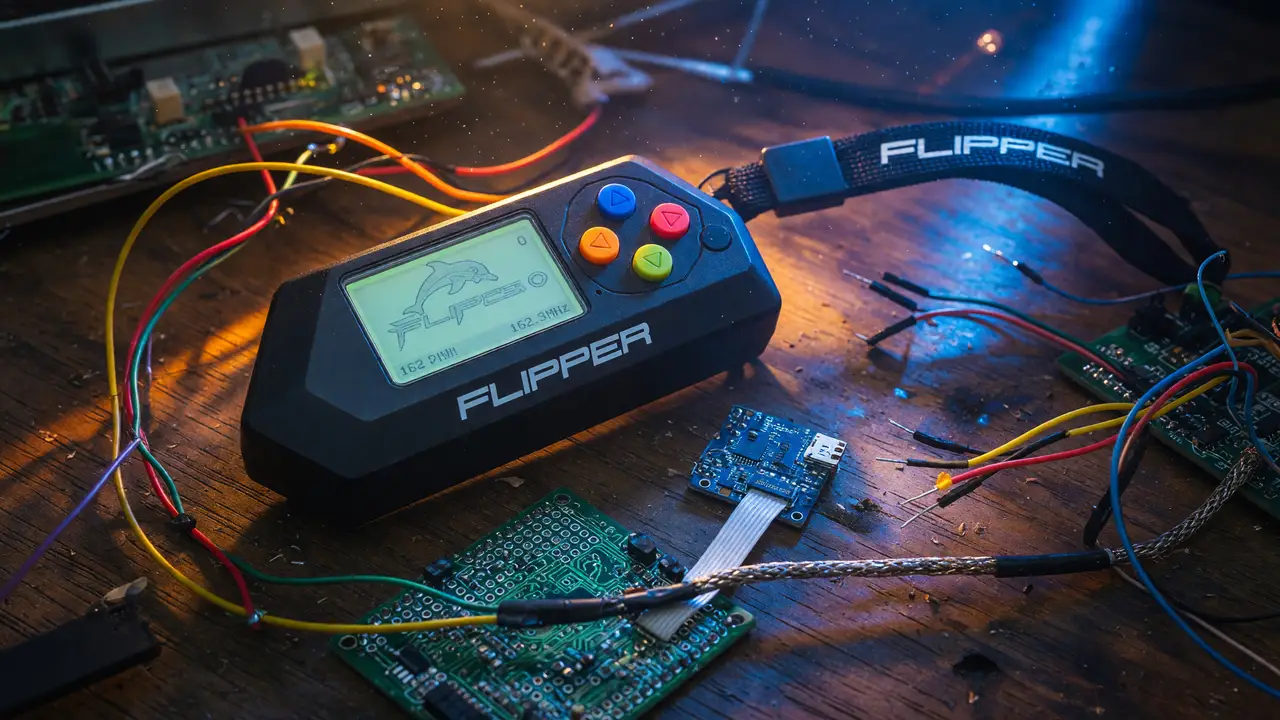
Flipper Zero in 2026: Is It Still the Ultimate Multi-Tool for Pentesting and Prototyping?
Explore whether the Flipper Zero at $169 remains the best multi-tool for pentesting and prototyping in 2026, with firmware updates, comparisons to Proxmark3 and M5Stack, and real-world limits.
The Flipper Zero launched as a compact, multi-protocol handheld that promised to replace a drawer full of test gear. Three years later, firmware sits at the 0.105.x series and no new silicon has appeared. The real question is whether that all-in-one form factor still justifies the $169 price when specialized tools keep closing the gap.
Pricing and Availability in 2025–2026
The official price has stayed at $169 for the black edition through the Flipper Devices store. Shipping still takes two to six weeks because of component sourcing and regional rules, though stock levels hold up for most buyers. Third-party listings sit between $180 and $220, mostly modest markups rather than signs of scarcity.
That price point matters. At roughly the cost of a mid-range phone, the device occupies a narrow band that few direct competitors target.
Firmware-Only Evolution
No hardware refresh or “Flipper One” shows up on any 2026 roadmap. Instead, monthly firmware updates have added rolling-code garage protocols, steadier ISO14443-A/B emulation, larger infrared databases, and improved GPIO scripting through the updated qFlipper tool. Each release builds on the same 2023-era silicon.
The practical effect is broader coverage of automotive and access-control targets without new radio hardware. Protocol support grows, but transmit power, antenna design, and processing headroom stay fixed.
Direct Comparison with 2025 Alternatives
Specialized devices have matured. The table below shows how three current options stack up against the Flipper Zero’s integrated approach.
| Device | Price | Core Strength | Weakness vs Flipper Zero | Best Paired With |
|---|---|---|---|---|
| Flipper Zero | $169 | Sub-GHz + NFC + IR + GPIO in one case | Limited depth on any single protocol | — |
| M5Stack Cardputer | $40–50 | Low-cost ESP32-S3 GPIO + Wi-Fi | No built-in Sub-GHz or RFID | Flipper or standalone |
| Proxmark3 RDV4.01 | $300–350 | High-frequency RFID/NFC cloning | Larger, single-purpose | Flipper for field work |
| HackRF One (kit) | ~$350 | 1 MHz–6 GHz SDR | No NFC/IR, steeper learning curve | Dedicated RF tasks |
Many engineers now carry a Flipper Zero for quick field checks and keep an M5Stack or Proxmark3 handy for deeper analysis.
Real-World Limitations Reported in 2025
Community reports keep circling back to four main constraints:
- Sub-GHz transmit range often needs external amplifiers for reliable car-key or gate work.
- NFC emulation still struggles with newer DESFire EV3 hotel and transit cards that a Proxmark3 handles cleanly.
- GPIO scripting stays basic; serious prototypes usually require an external microcontroller.
- Longer Sub-GHz or infrared sessions drain the battery and produce noticeable heat within 30–45 minutes.
These limits don’t make the device useless—they simply define its role as a first-line scanner rather than a full lab replacement.
Decision Framework for Buyers
flowchart TD
    A[Need quick multi-protocol checks?] -->|Yes| B[Budget under $200?]
    A -->|No| C[Choose specialized tool]
    B -->|Yes| D[Flipper Zero]
    B -->|No| E[Add M5Stack or Proxmark3]
    D --> F[Pair with external amp or MCU if needed]
Reach for the Flipper Zero when portability and breadth matter more than maximum depth on any single protocol. Add a dedicated tool only when a specific target keeps failing emulation.
Practical Takeaways
- At $169, the Flipper Zero remains the cheapest way to carry Sub-GHz, NFC, IR, and basic GPIO in one pocket-sized unit.
- Firmware updates through 2025 have stretched its useful life without any hardware changes.
- Pairing it with a $40–$50 M5Stack Cardputer or a Proxmark3 covers most gaps field users report.
- Expect the same physical limits—range, emulation depth, and battery life—to persist through at least 2026.
The Flipper Zero is no longer the only game in town, but its mix of price, size, and continued protocol support keeps it relevant as a daily driver for engineers who need quick reconnaissance more than exhaustive single-protocol work.