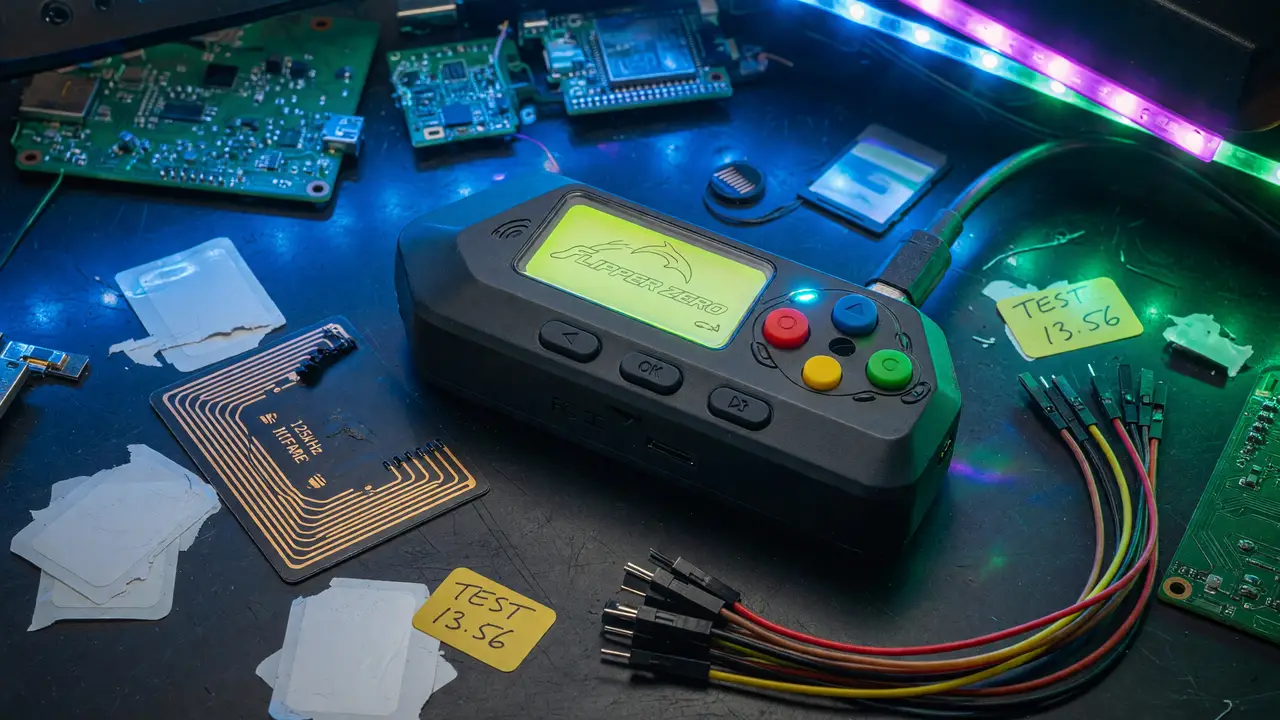
Flipper Zero in 2026: Is It Still the Ultimate Multi-Tool for Pentesting and Prototyping?
In 2026, does the Flipper Zero still hold up as the ultimate pentesting and prototyping device? We compare hardware, pricing, firmware, and alternatives like Proxmark3 and ESP32 tools.
The Flipper Zero hit the market in 2020 with hardware that never changed. Six years on, it still commands premium prices even as faster, cheaper options built around ESP32 chips and dedicated SDR boards have flooded in. For engineers and pentesters, the real question is whether the original device still earns its spot in a pocket or has simply become a legacy gadget.
Hardware That Refused to Evolve
The core specs remain exactly what shipped at launch: an STM32WB55RG dual-core MCU, TI CC1101 sub-GHz transceiver, ST25R3916 NFC reader, 125 kHz RFID support, and that familiar 1.4-inch 128×64 monochrome screen. Battery life still lands in the 7–14 day range with the 2000–2100 mAh cell.
No pinout updates, no native Wi-Fi, and no RAM or flash upgrades. The 13–18 GPIO pins stay at 3.3 V CMOS with 5 V tolerance. That consistency makes life easier for developers who already have working code, but it also limits what the device can do against newer encrypted protocols that faster MCUs handle natively.
Current Pricing and Market Position
Official pricing rose from $169 to $199 in late 2025. Third-party listings now run $199–289, with some regions seeing spikes up to $350 AUD or ₹39,999. Add the Wi-Fi Dev Board and you’re looking at another $29.
At those prices the Flipper Zero sits above most ESP32-based tools and near the entry point for Proxmark3 RDV4 kits. What you’re paying for is the integrated screen, physical buttons, and broad protocol coverage in one package.
How It Compares to 2026 Alternatives
Specialized tools have pulled ahead in specific areas, while ESP32 devices have narrowed the gap on cost and convenience.
| Device | Price Range | Strengths | Weaknesses | Best For |
|---|---|---|---|---|
| Flipper Zero | $199–289 | All-in-one, screen, portability | Limited CPU, no native Wi-Fi | Beginners, quick field work |
| Proxmark3 RDV4 | $149–350 | Best RFID/NFC depth | No sub-GHz or display | Professional RFID work |
| HackRF One + Portapack | $300–450 | 1 MHz–6 GHz SDR | Requires add-on or laptop | Wideband RF research |
| Chameleon Ultra | $110–160 | Credit-card NFC/RFID emulation | Single protocol family | Card cloning on the go |
| LilyGo T-Embed CC1101 | $25–80 | Cheap Wi-Fi/BLE + sub-GHz | Weak 125 kHz RFID | Budget Wi-Fi pentesting |
The Flipper Zero still wins when you need one device to handle sub-GHz, NFC, RFID, infrared, and basic GPIO without juggling extra boards.
Firmware Progress Without Hardware Change
Official firmware reached the v1.4.x series by late 2025, bringing better BLE stability, wider sub-GHz protocol support, and improved plugin documentation. Community forks like Unleashed and RogueMaster keep shipping new features ahead of the official branch.
In May 2026 the company announced “Flipper One,” a Rockchip RK3576 Linux device with 8 GB RAM and Wi-Fi 6E. It targets network work and portable Linux use cases rather than replacing the original Zero form factor. A second-generation Flipper Zero has not been confirmed.
Many users manage updates and custom plugins through the command line. Connect the device and run a quick status check like this:
flipper-cli device_infoOr flash a community firmware build with:
qflipper --firmware unleashedReal-World Effectiveness in 2025–2026
Field reports from working pentesters show near-100 % success on common 125 kHz cards and MIFARE Classic/Ultralight tags. Sub-GHz replay attacks still work reliably on non-rolling-code garage doors and older IoT sensors at 20–35 ft. Rolling-code systems continue to block simple replays.
The device shines for quick GPIO prototyping and teaching. Heavy wireless use drains the battery faster, and anything involving complex encryption quickly hits the 64 MHz Cortex-M4 ceiling. Most experienced users now treat the Flipper Zero as a scouting or entry-level tool and reach for a Proxmark3 or HackRF when they need deeper capability.
Practical Takeaways
- Grab the Flipper Zero when you want one compact device that covers the widest range of legacy protocols without extra hardware.
- Add the official Wi-Fi board or a cheap ESP32 companion if 2.4 GHz work matters.
- Go with Proxmark3 or HackRF when your focus is high-security RFID or wideband spectrum analysis.
- Keep an eye on firmware releases—software updates continue to extend the device’s life even without hardware changes.
The Flipper Zero remains the strongest beginner multi-tool in 2026. It is no longer the single best device for every pentesting or prototyping scenario.