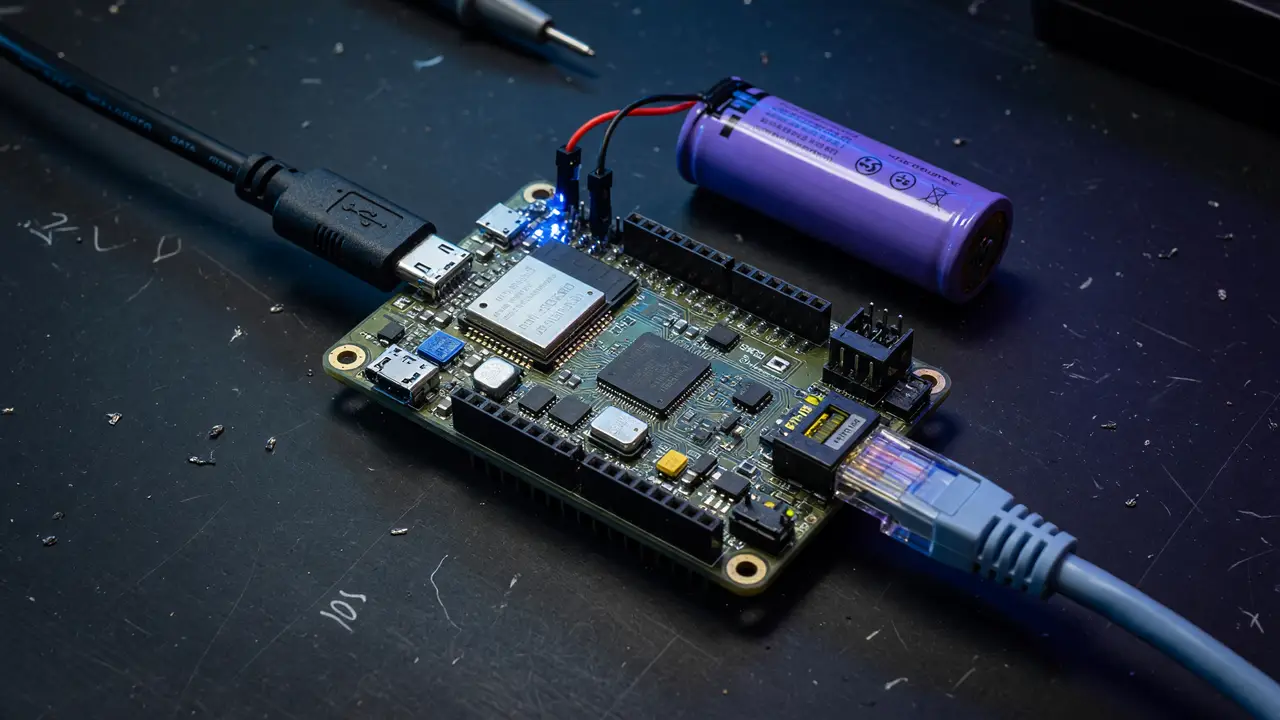
How to Power Your ESP32 Projects: Battery, USB, or PoE?
Choosing between USB, battery, or PoE for ESP32 projects? Covers power requirements, current draw, runtime estimates, and recommended boards for reliable operation.
Picking the right power source often decides whether an ESP32 project runs reliably or drops out the moment the radio kicks in. The chip needs 2.3–3.6 V and at least 500 mA of supply current, which immediately rules out a lot of quick-and-dirty setups.
ESP32 Power Requirements at a Glance
Espressif specifies a single 3.3 V rail that can deliver 500 mA. Peak draw hits 240 mA during Wi-Fi transmission at full power, while a well-optimized board can sit at just 5–10 µA in deep sleep. Most real dev boards land between 5–15 mA in sleep because of regulators and LEDs.
| Mode | Typical Current | Notes |
|---|---|---|
| Wi-Fi TX | 180–240 mA | Peak at full power |
| Wi-Fi RX | 95–100 mA | Steady receive |
| Bluetooth TX | 130 mA | — |
| Deep sleep (RTC only) | 5–10 µA | Ideal case; board leakage higher |
| Deep sleep + ULP | up to 150 µA | Coprocessor active |
Those numbers explain why weak supplies cause brownouts right when the radio turns on.
USB Power: Stable but Limited
Most DevKit boards take 5 V from USB or the 5 V pin and regulate it down to 3.3 V. The onboard regulators usually handle the 240 mA peaks without trouble when you power through the USB port. Feeding 5 V straight to the 5 V pin can cause boot issues on some boards because of differences in the USB-to-UART diode path.
For development and short tests, USB remains the easiest option. It avoids voltage sag and keeps things simple.
Battery Power: Runtime Depends on Wake Strategy
Battery life comes down to sleep current and regulator efficiency. A 1000 mAh LiPo might only last four hours with continuous Wi-Fi. Switch to duty-cycled operation and the numbers improve fast.
- 2000–3000 mAh cell, 30-second wake interval → roughly 15 days
- Same cell, 5-minute interval → about 75 days
- Optimized board under 50 µA sleep with hourly wakes → 100+ days
Plan on losing 20–30 % to regulator quiescent current and battery self-discharge. Boards that still use the AMS1117 LDO are especially wasteful—the regulator often burns more power than the ESP32 itself.
PoE Boards: Integrated Power and Ethernet
Three boards that add IEEE 802.3af/at PoE are easy to find:
| Board | PoE Standard | Max Power | Price (approx.) | Notes |
|---|---|---|---|---|
| Olimex ESP32-POE | 802.3af | ~12 W | €17.95 | LAN8710, LiPo charger |
| Olimex ESP32-POE2 | 802.3at | 25 W | €20.95 | Higher current capability |
| LILYGO T-Internet-POE | 802.3af | ~12 W | $11–19 | Often includes TF-card slot |
PoE gives clean 3.3 V and 5 V rails, though some Olimex users see Wi-Fi dropouts when running only on Ethernet. You need at least 37 V at the input and about 12 mA to satisfy the power signature. Never connect both USB and PoE at the same time on non-isolated designs.
Cost and Decision Trade-offs
Plain ESP32 DevKit boards run $1–6 on AliExpress and $7–13 on Amazon. PoE versions carry a 2–4× premium. For always-on sensors with Ethernet nearby, PoE removes battery changes and gives you a wired link. For portable or remote nodes, a battery plus aggressive deep-sleep intervals is usually cheaper and more flexible.
A 500 mA 3.3 V rail is non-negotiable once the radio wakes.
Choosing the Right Approach
Match the power method to how the device will actually be used:
- Development or bench testing → USB
- Battery-powered with infrequent transmissions → 2000 mAh+ cell and <50 µA sleep
- Fixed install with Ethernet available → Olimex or LILYGO PoE board
Check the regulator rating on your specific board and measure real sleep current before you commit to long deployments. Those measured values, not the datasheet numbers, determine how long the device will actually last.