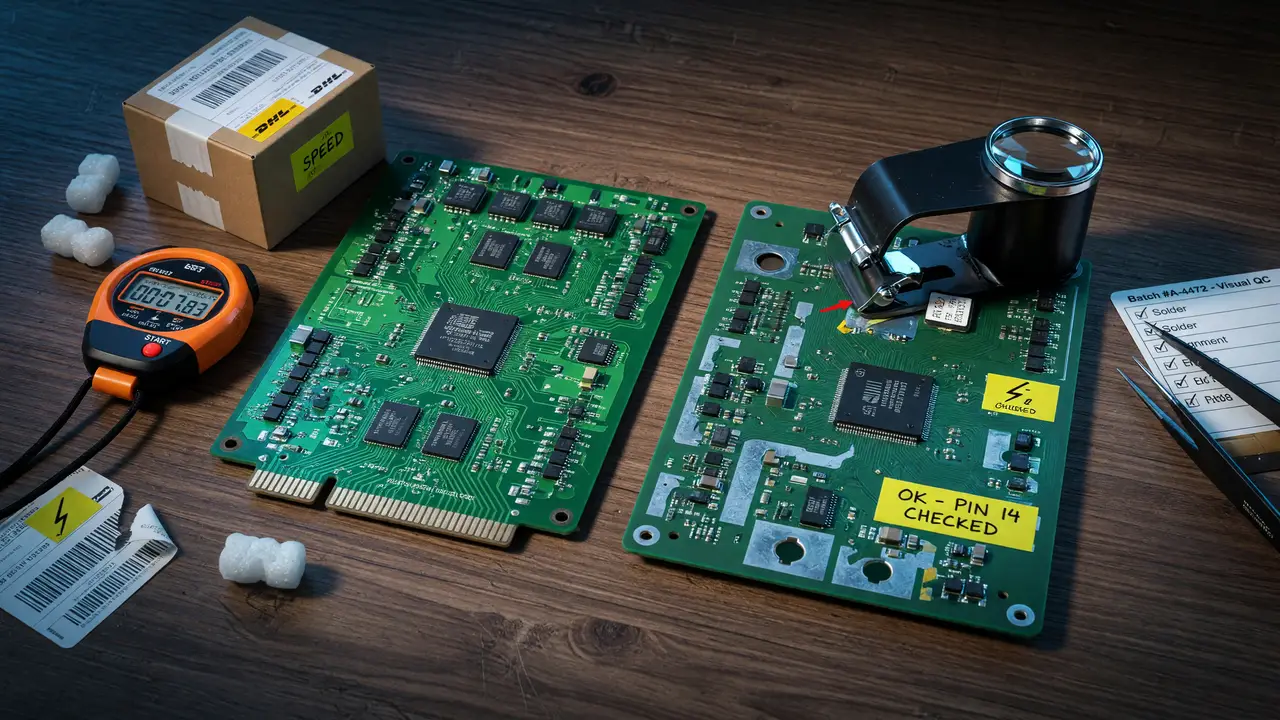
JLCPCB vs PCBWay: An Honest Comparison of Turnaround Time and Quality
Compare JLCPCB and PCBWay on turnaround, US shipping, quality, and support with real-world data to help choose the right PCB fab.
Engineers and makers keep running into the same decision: JLCPCB for low cost and speed, or PCBWay when consistency and support matter more. The gap between quoted lead times and actual delivery often settles the question for any given project.
Advertised Lead Times
Both fabs advertise 24-hour turnaround on small runs, though real results vary with layer count and order volume.
Standard production times (≤100×100 mm boards, FR4 1.6 mm, 1 oz copper)
| Layers | JLCPCB (5–50 pcs) | PCBWay (0–50 pcs) | Expedited Option |
|---|---|---|---|
| 2 | 24 h–2 days | 24 h–3 days | Both offer 24 h rush |
| 4 | 2–5 days | 5 days standard | PCBWay 48 h rush (+$80–150) |
JLCPCB usually posts shorter standard times on 4-layer boards. PCBWay can close the gap with weekend processing on some orders.
Real Delivery Times to the US
Production speed only tells part of the story once shipping starts.
JLCPCB’s DHL Express shipments typically reach the US in 3–5 business days after fabrication. Most 2-layer prototypes arrive in 5–8 days total. Economy shipping stretches that to 8–14 days. Temporary surcharges applied from September 2024 through January 2025.
PCBWay’s DHL/FedEx service averages 5–7 business days, pushing most orders to 7–10 days end-to-end. Their cheaper Global Standard option adds more time.
Both fabs beat their worst-case estimates on small orders more often than not, though shipping remains the largest source of uncertainty.
Quality and Consistency
Feedback from 2023–2025 shows clear patterns.
JLCPCB delivers accurate traces and functional boards at low cost. Common complaints include thin solder mask, faint silkscreen, and occasional plating issues. Assembly orders see higher defect rates, such as misoriented parts or missing components. Trustpilot score sits at 3.1/5.
PCBWay receives stronger marks for crisp silkscreen and registration quality. Assembly defects appear less frequently, and Trustpilot averages 4.1–4.2/5. Users report better legibility even with fine text.
“For bare boards under $10, JLCPCB is hard to beat. Once you add assembly or need reliable support, PCBWay pulls ahead.”
Support and Problem Resolution
Defective boards highlight the biggest difference between the two.
JLCPCB often issues replacement vouchers rather than quick fixes, which can prolong discussions on EEVblog and Reddit. PCBWay earns more consistent praise for remaking faulty boards with less back-and-forth.
Simple 2-layer prototypes rarely need much support, so JLCPCB’s lighter approach works fine. Complex or assembled boards benefit more from PCBWay’s follow-through.
Practical Decision Guide
Match the fab to your priorities:
- Choose JLCPCB for the lowest price on standard 2-layer boards when minor cosmetic variation is acceptable and bare-board speed matters most.
- Choose PCBWay when the design calls for fine silkscreen, tight tolerances, or assembly, or when responsive support matters if problems arise.
- Factor shipping method into the timeline early—DHL Express narrows the total gap between the two services.
Key Takeaways
Both fabs regularly deliver faster than advertised on small runs. JLCPCB wins on raw cost and speed for basic boards. PCBWay provides better perceived consistency and support once projects move past simple prototypes. Weigh your tolerance for cosmetic defects and assembly risk against the modest price difference before ordering.