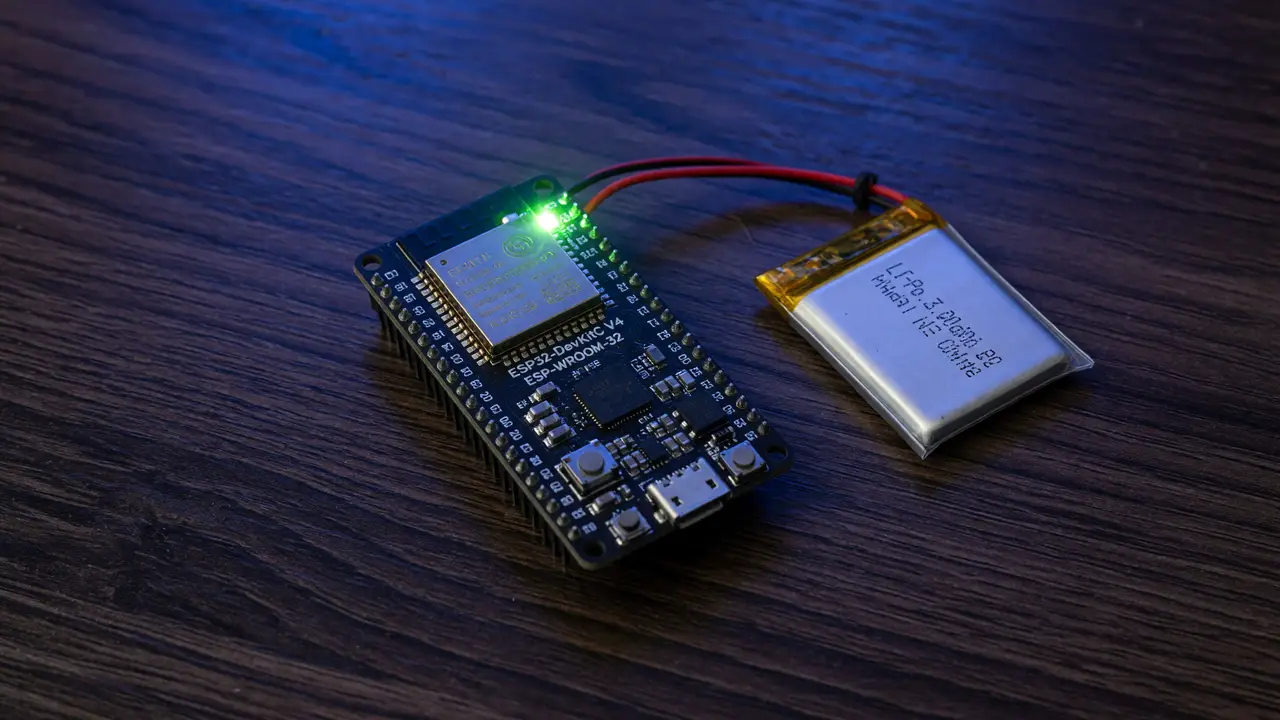
Low Power Settings: How to Optimize Your ESP32 for Deep Sleep and Battery Life
Optimize ESP32 boards for deep sleep to hit 5–10 µA draw. Hardware tweaks, firmware settings, sleep mode comparisons, and measured battery life results.
Most ESP32 dev boards drain their batteries in a few days. Stock regulators, always-on LEDs, and default firmware keep current draw in the milliamp range. Reaching the chip’s real deep-sleep floor of 5–10 µA requires targeted changes on both the hardware and firmware side.
Why Stock Boards Fail to Last
A typical development board still pulls 5–15 mA even when supposedly asleep. That’s mainly from the LDO’s quiescent current and those always-lit LEDs—roughly 500–1,000× higher than the datasheet claims. A 2,000 mAh cell won’t last long under those conditions.
Pull the power LED and swap the regulator for a low-Iq part such as the HT7333 or MCP1700, and board-level sleep current drops straight to the 50–200 µA range. Cutting the 3.3 V rail to the Wi-Fi section when it isn’t needed brings further improvement.
Sleep Modes Compared
The ESP32 family gives you three main low-power states. The table below compares datasheet figures with what you’ll actually see on an optimized board.
| Mode | Chip (RTC on) | Optimized Board | Wake Latency | RAM Retained |
|---|---|---|---|---|
| Light sleep | 0.8 mA | 2–5 mA | <3 ms | Yes |
| Deep sleep | 5–10 µA | 50–200 µA | 200–500 ms | Partial |
| Hibernation | ~5 µA | 20–50 µA | 200–500 ms | No |
Light sleep simply clock-gates the CPU while keeping all RAM alive, so it works well for wake-ups under a second. Deep sleep shuts down almost everything except the RTC timer and optional ULP coprocessor. Hibernation goes further by disabling the RTC memory and oscillator, which gives the lowest current but erases retained variables.
Reaching Datasheet Current
Follow this sequence to hit single-digit microamps:
- Remove or disable every LED and pull the GPIO0/GPIO2 lines low.
- Replace the onboard LDO with a part whose quiescent current sits below 5 µA.
- Call
esp_sleep_pd_config()to power down unused RTC peripherals. - Pick the right wake source—timer, external, or ULP—and make sure the Wi-Fi/BT radio is fully powered off.
esp_sleep_pd_config(ESP_PD_DOMAIN_RTC_PERIPH, ESP_PD_OPTION_OFF);
esp_sleep_pd_config(ESP_PD_DOMAIN_RTC_SLOW_MEM, ESP_PD_OPTION_OFF);
esp_deep_sleep_start();
These functions stabilized in ESP-IDF v5.0, which also fixed most of the low-power quirks across the ESP32-S2, S3, and C3 variants.
Measured Battery Life
Once the board is properly optimized, real-world results look like this:
- Wake every 20 seconds for 4 seconds of work → ~43 days on a 2,500 mAh 18650
- Five-minute interval with a 3-second Wi-Fi burst → ~300 days
- Once-per-hour 8-second transmission on an XIAO ESP32-C3 (47 µA sleep) → 1–2 months practical, up to 2.5 years theoretical with derating
Cell self-discharge (2–5 % per month) and Wi-Fi association time remain the biggest unknowns.
ESP32 Versus nRF52840 and STM32L4
| Chip | Deep-sleep Current | Integrated Wi-Fi | Best Use Case |
|---|---|---|---|
| ESP32 family | 5–10 µA (chip) | Yes | Projects needing 802.11 |
| nRF52840 | <1 µA | No | BLE coin-cell sensors |
| STM32L4 | 0.3–0.4 µA | No | Ultra-long life, no wireless |
The ESP32 trades a 10–50× power penalty in deep sleep for the convenience of built-in Wi-Fi. When your application only needs the network every few minutes or longer, that trade-off usually makes sense. For true multi-year coin-cell operation without wireless, the nRF or STM32L4 is the clearer choice.
Practical Takeaways
Measure sleep current with a microamp meter after each change. Aim for under 100 µA total at the battery if you want multi-month runtime. Use ESP-IDF v5.0 or newer, disable unused power domains, and keep Wi-Fi association under five seconds per cycle. Meet those constraints and a 2,000–3,000 mAh cell can realistically give you three to twelve months of operation while still delivering wireless connectivity.