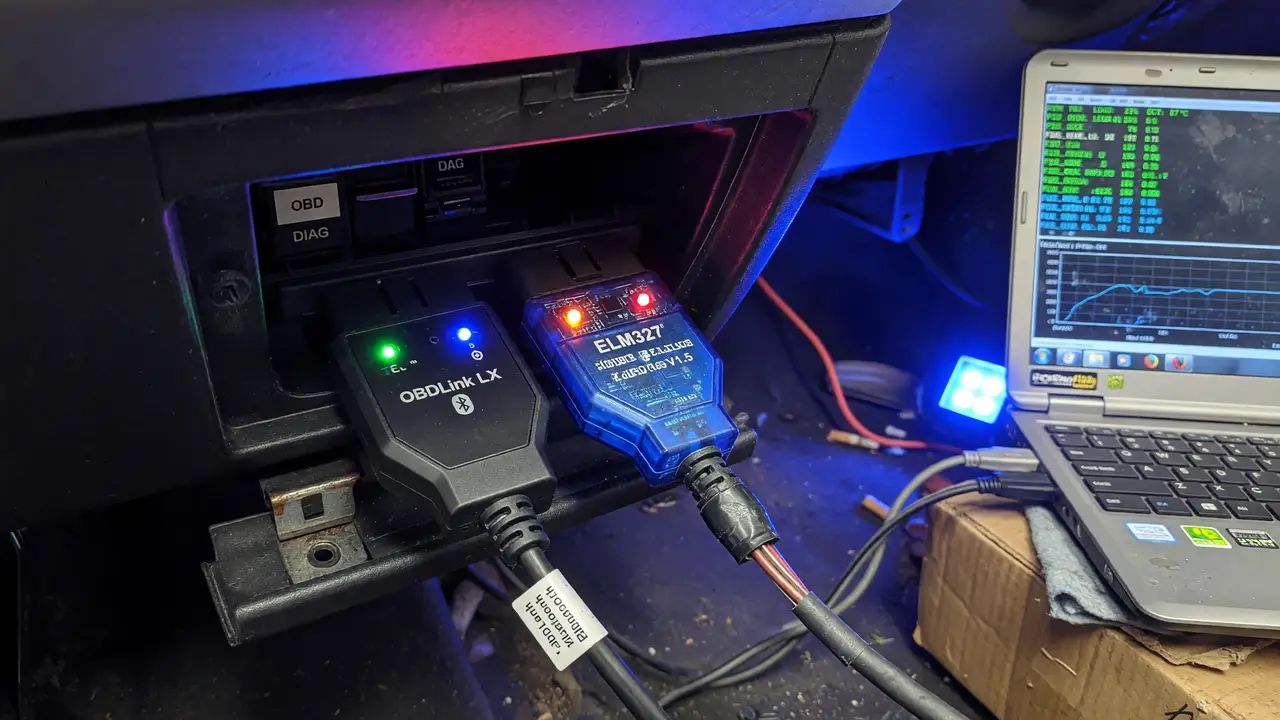
OBDLink LX vs Cheap ELM327 Clones for Data Logging
Compare OBDLink LX and cheap ELM327 clones for OBD-II data logging stability, protocol support, and real-world reliability in continuous sessions.
Review: OBDLink LX vs Cheap ELM327 Clones for Data Logging
Plenty of makers grab the cheapest Bluetooth OBD-II adapter on Amazon, only to see their logging sessions fall apart after ten minutes. The difference between a purpose-built device and a generic clone shows up fast once you need continuous data collection.
Hardware and Chipset Differences
The OBDLink LX runs on an STN chipset instead of any ELM327 derivative. It handles every legislated OBD-II protocol in hardware, including full J1850 PWM/VPW and extended CAN frames. Cheap clones typically use a PIC18F25K80 or smaller parts running software CAN stacks that often drop multi-ECU responses.
Size and build also set them apart. The LX measures 50 × 45 × 23 mm and weighs 34 g. Most clones use the same plastic shell but skip the physical pairing button and proper voltage regulation.
Protocol Coverage and Throughput
| Feature | OBDLink LX | Typical <$20 ELM327 Clone |
|---|---|---|
| Sustained PID rate | ~100 PIDs/s | 10–20 PIDs/s |
| Full CAN 11/29-bit | Yes | Partial, frequent bugs |
| J1850 PWM/VPW | Hardware support | Often missing or unstable |
| Buffer size | Large, hardware-managed | Minimal or absent |
| Automatic sleep | <2 mA BatterySaver mode | None; constant drain risk |
The LX holds these rates across long sessions because its connection algorithm and buffer keep packet loss in check. Clones lose sync once the vehicle’s bus load climbs.
Price and Ownership Cost
Retail pricing stays fairly steady. The OBDLink LX sells for $89.95 direct or $79.95–$89.95 on major marketplaces. Entry-level clones start at $8–$15, with slightly better-known options like BAFX or Veepeak around $25.
The four- to eight-times price gap matters less when a failed logging run wastes hours of track time or fuel-economy data. Three-year warranty coverage and ongoing firmware updates on the LX also tilt the long-term cost in its favor.
Logging Stability in Real Use
Users running Torque Pro or OBDwiz report consistent first-try connections and multi-hour sessions without drops when using the LX. Its 60–68 mA operating current and sub-2 mA sleep mode make permanent installation practical without draining the battery.
Clone reports show the same pattern again and again: initial success followed by disconnections, missing PIDs, or even spurious dash warnings. Several documented cases show clones generating signals that trigger ABS or other fault lights.
“You get what you pay for” appears across Torque forums and r/CarHacking threads after users test both options on the same vehicles.
Security and Firmware Support
The LX requires a physical button press to pair and uses 128-bit encryption over Bluetooth 3.0 SPP. Clones broadcast openly and accept easily guessed four-digit PINs, opening a remote-access vector.
Firmware on the LX stays actively maintained. Free updates arrive through the OBDLink app or Windows utility, and you can restore factory settings with a button press if needed. Most clones ship with frozen, mislabeled firmware that cannot be updated.
CLI Configuration Examples
For scripted logging setups on a Raspberry Pi or similar, the LX accepts standard AT commands over the serial profile. Here are common sequences used to prepare a stable session:
# Connect and reset
echo -e "ATZ\r" > /dev/rfcomm0
echo -e "ATE0\r" > /dev/rfcomm0   # echo off

# Set protocol and enable adaptive timing
echo -e "ATSP0\r" > /dev/rfcomm0
echo -e "ATAT1\r" > /dev/rfcomm0

# Increase buffer and start monitoring
echo -e "ATSTFF\r" > /dev/rfcomm0
echo -e "0100\r" > /dev/rfcomm0
Clones often ignore or mishandle the same commands, especially ATST and adaptive timing adjustments.
Practical Takeaway
For one-off code reading, a $15 clone may suffice. For any continuous logging workload—track telemetry, long-term efficiency studies, or multi-ECU diagnostics—the OBDLink LX delivers measurable stability, full protocol coverage, and safety margins that justify its cost.
Choose based on session length and data reliability requirements rather than initial purchase price.