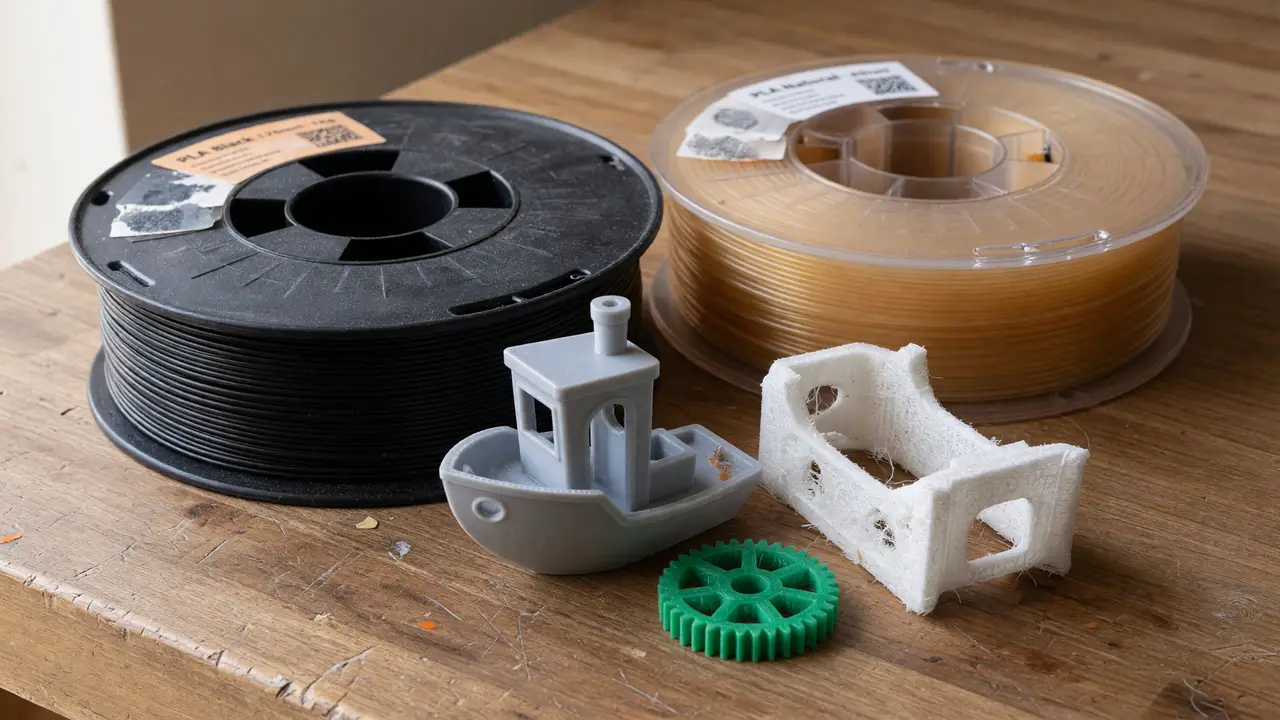
Review: PolyLite PLA vs Prusament – Which Filament Delivers the Best Finish?
Compare PolyLite PLA and Prusament on tolerance, price, colors and surface finish to decide which filament delivers the best 3D printing results.
Two premium PLA filaments sit near the top of many makers’ lists. Prusament promises tight tolerances and backs every spool with verifiable measurements. PolyLite costs roughly half as much yet still aims for smooth, reliable prints. Surface finish often decides which one wins for a given user.
Diameter Tolerance and Quality Verification
Prusament holds diameter to ±0.02 mm and roundness to ±0.01 mm. A QR code on each spool links to actual measurements taken at regular intervals, plus weight, length, and ovality numbers. Independent checks with calipers have matched those published values.
PolyLite states ±0.05 mm tolerance, with some spools hitting ±0.03 mm. It offers no per-spool data. The gap becomes noticeable on large parts where small variations accumulate.
Prusament supplies documented per-spool numbers. PolyLite supplies a published tolerance.
Price Comparison
| Filament | Typical Retail (1 kg) | Sale Range | Notes |
|---|---|---|---|
| PolyLite PLA | $19.99–$22.99 | $13.59–$18 | Frequent stock at Polymaker and resellers |
| Prusament PLA | $29.99 | $24 (clearance) | US warehouse pricing; higher at some shops |
Prusament runs 40–50 % higher on most days. Once both filaments clear the “acceptable finish” bar, price usually settles the choice.
Color Range and Specialty Finishes
Both brands cover a broad palette. Prusament offers more than 40 named colors. PolyLite splits its range into matte (PolyTerra) and silk lines. Glitter and galaxy effects live inside Prusament’s main PLA lineup, while Polymaker keeps those in separate product families.
Standard Prusament tends to give a consistent matte-to-satin surface that softens layer lines. PolyLite often shows a light gloss that can highlight layers unless the temperature is dialed in.
Surface Finish Performance
No public studies give direct Ra numbers for the two filaments. Forum reports and bench tests place both in the premium tier:
- Minimal stringing after drying and tuning
- Good detail retention on fine features
- Occasional batch-to-batch gloss shifts with Prusament
Layer height and cooling still matter more than brand for final roughness. Side-by-side prints show no clear, consistent winner.
Decision Framework
Here’s a quick way to decide:
- Need maximum dimensional certainty and batch traceability → Prusament
- High print volume and “good enough” finish at lower cost → PolyLite
- Want matte or silk effects without switching brands → Look at PolyTerra or Panchroma alongside PolyLite
- Color-critical work where perceived quality counts → Prusament’s satin finish often looks better
flowchart TD
    A[Start] --> B{Need documented tolerance?}
    B -->|Yes| C[Choose Prusament]
    B -->|No| D{High volume or tight budget?}
    D -->|Yes| E[Choose PolyLite]
    D -->|No| F{Want matte/silk without new brand?}
    F -->|Yes| G[Try PolyTerra or Panchroma]
    F -->|No| H[Prusament for visual finish]
Pick based on tolerance transparency versus price-to-performance.
Both filaments turn out clean, reliable parts on a well-tuned printer. Prusament’s measurable consistency and professional matte look justify the extra cost when documented quality matters. PolyLite narrows the finish gap for most functional parts while keeping the cost per kilogram low. The right choice comes down to whether your workflow values verifiable spool data or simply wants to stretch the filament budget further.