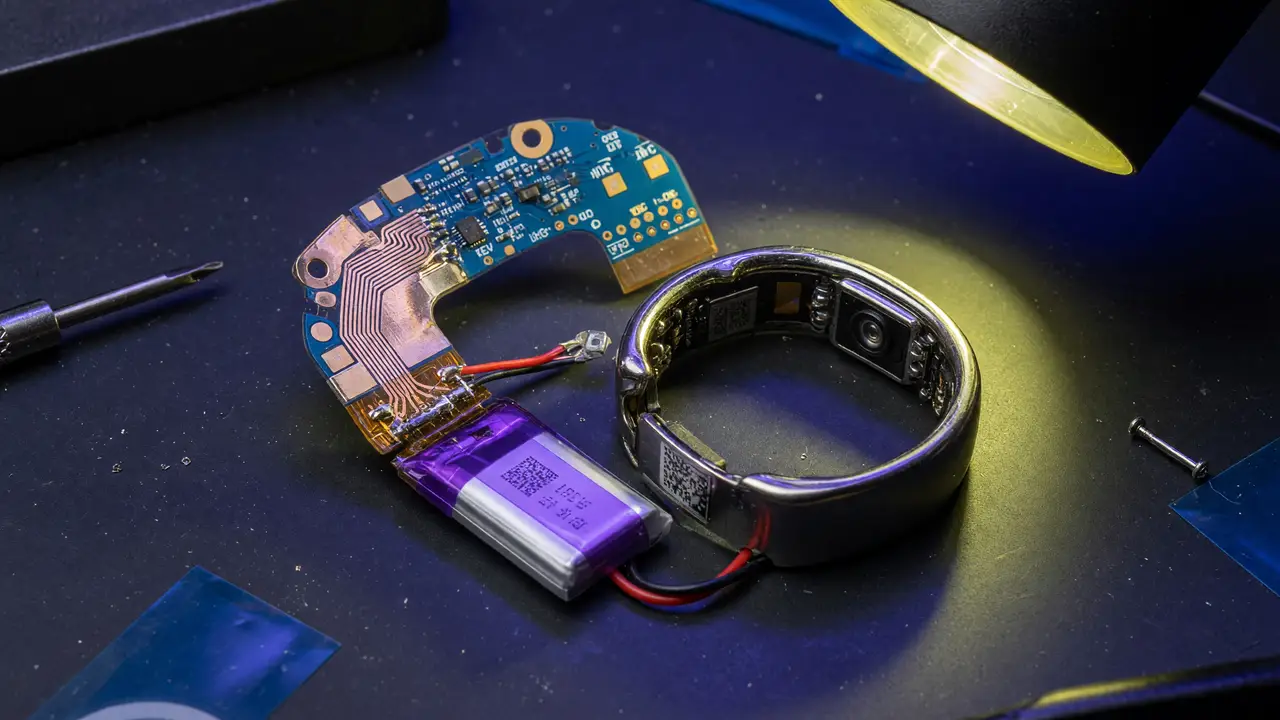
Prototyping a Custom Smart Ring: The Challenges of Flexible PCBs and Tiny Batteries
Explore the engineering trade-offs of curved LiPo cells under 20 mAh and double-sided flex PCBs with sub-5 mm bend radii when prototyping a 2.5 mm thick smart ring.
Packing a week of biometric sensing, wireless connectivity, and continuous operation into a 2.5 mm thick ring forces some tough choices. Two constraints stand out immediately: curved lithium-polymer cells that rarely exceed 20 mAh, and double-sided flex circuits that must handle repeated bends in the 5–8 mm range.
Battery Capacity vs. Runtime Trade-offs
Commercial rings already sit right at the edge of what’s practical. Real-world numbers show how far datasheet specs drift from daily use.
| Ring Model | Capacity | Typical Runtime | Thickness | Charge Time |
|---|---|---|---|---|
| Oura Ring Gen3 | 15–22 mAh | 4–7 days | 2.7–2.9 mm | 20–80 min |
| Ultrahuman Ring AIR | 24 mAh | 4–6 days | 2.45 mm | 1.5–3 h |
Both rely on non-replaceable 3.7 V LiPo cells built into the ring body. Size 6 Oura rings bottom out at 15 mAh; larger sizes reach 22 mAh. Ultrahuman’s 24 mAh cell gives a bit more margin, but it still requires heavy power gating to keep SpO2 and continuous HRV running.
Available Curved LiPo Cells for Prototypes
Off-the-shelf curved cells exist, though the options thin out fast once you drop below 20 mAh.
- Grepow GRP170722 / LPCV170722: 14.5–15 mAh, 1.7 × 7 × 22 mm, inner arc radius ≈10.55 mm
- LiPol LPCV170723–726: 16–19 mAh, 1.7 × 7 × 23–26 mm
- Grepow LPCV140425: 6.1 mAh, 1.4 × 4 × 25 mm (smallest stocked option)
- Ufine/Alibaba CT150730 series: 16–20 mAh, 1.5 × 6.9 × 25–30 mm
All of these run from –20 °C to +60 °C. Solid-state options at this capacity aren’t available in production volumes yet. MOQs are low for prototypes, but custom curvatures still take 6–8 weeks.
Flex PCB Stack-up and Bend-Radius Limits
Hitting a continuous bend radius under 5 mm on a double-sided flex board means thinning everything down. PCBWay’s guidelines are useful here:
- Minimum practical stackup for dynamic flex: 0.22–0.30 mm total thickness
- Recommended bend radius: 7–10× thickness for dynamic use (roughly 2–3 mm for 0.3 mm boards)
- Rigid-flex hybrids are the safer route; pure flex boards lose yield when components sit in the bending zone
Prototype runs under 50 units usually land between $50–200 plus shipping. Lead times run 7–20 days, with 2–5 day turns only on simpler single-layer designs. Minimum board width hovers around 2 mm.
Construction Details from Commercial Teardowns
Oura’s Gen2 and Gen3 rings wrap a continuous curved flex around a titanium inner band. The flex itself is about 0.22 mm thick, while the rigid islands that carry the MCU and sensors reach 0.48 mm. Parts stay low-profile—WL-CSP packages under 3 mm, dense SMT on the inner wall, and multilayer copper for the antenna and photodiode array. RingConn uses a similar layout. Both keep active circuitry on the neutral axis or rigid islands to reduce trace stress.
Failure Modes and Mitigation Data
Field data points to the main risks at these small diameters.
- 65 % of wearable flex failures come from fatigue; copper trace fracture makes up about 40 % of those
- Trace cracking can show up in as little as 30 hours under repeated bioimpedance bending
- Commercial rings target 100 k–500 k cycles; early rigid-flex prototypes without extra care hit 28 % failure rates
Useful mitigations include rolled-annealed copper, serpentine routing, neutral-axis placement, parylene coating, and rigid islands for the ICs. One documented smart-ring CGM project reached 300 k cycles at a 6 mm radius with these steps.
Practical Takeaways for Your Prototype
Start with a rigid-flex stack-up and the smallest stocked curved cell that still meets your runtime goal. Test the bend radius on a mechanical mock-up before ordering populated boards. Plan for at least two flex revisions and source cells with documented arc radii instead of hoping flat cells will bend cleanly.
The real limit isn’t silicon or algorithms. It’s keeping the interconnects intact inside a 2.5 mm envelope.