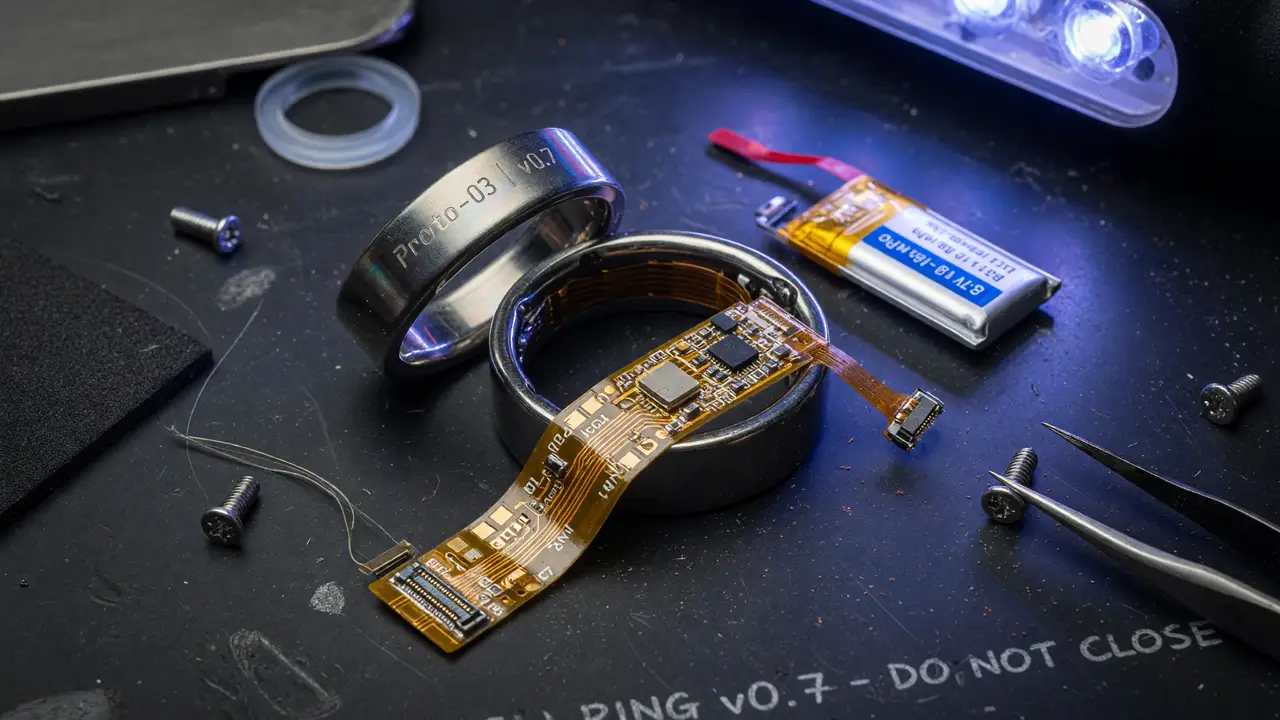
Prototyping a Custom Smart Ring: The Challenges of Flexible PCBs and Tiny Batteries
Explore challenges of building custom smart rings with flexible PCBs and sub-25 mAh batteries. Compare Oura and Galaxy Ring specs plus practical prototyping tips and design rules.
Smart rings promise continuous health tracking in a package smaller than most watches. Curved space imposes tight limits on batteries and circuitry. Commercial devices like the Oura Ring Gen3 and Samsung Galaxy Ring reach 6–7 days of runtime with cells no larger than 23 mAh. Matching that performance in a custom build quickly forces trade-offs around power sources and flex boards.
Battery Limits in a Finger-Worn Package
Both flagship rings use size-specific curved or flexible cells to stay under 3 mm thick. The Oura Gen3 carries 15–22 mAh depending on ring size; the Galaxy Ring uses 17–23.5 mAh cells. Real-world runtimes land between 4 and 7 days when SpO₂ sampling is enabled.
Those figures set a firm ceiling for any DIY project. A custom ring must fit its battery inside a 7–8 mm wide, 2.5–3 mm thick annulus that can survive repeated flexing and body heat.
Key commercial specs
| Device | Capacity range | Thickness | Weight | Runtime (typical) | Charge time |
|---|---|---|---|---|---|
| Oura Ring Gen3 | 15–22 mAh | 2.55–2.9 mm | 4–6 g | 4–6 days | ~2 h |
| Galaxy Ring | 17–23.5 mAh | 2.6 mm | 2.3–3 g | 6–8 days | 80–90 min |
Sourcing Sub-25 mAh Cells
Off-the-shelf coin cells are the quickest option for prototypes, though they rarely match the curved shape. Murata and Panasonic supply most of the small lithium manganese dioxide cells on the market.
- CR1220: 35–40 mAh, Ø12.5 × 2.0 mm
- CR1616: 55 mAh, Ø16 × 1.6 mm
- CR2016: 90 mAh, Ø20 × 1.6 mm
Pouch-style LiPo cells conform better but start around 10–20 mAh once you drop below 2 mm thickness. The smallest Murata cells run $2–13 in low quantities; truly curved custom cells cost more and take longer to arrive.
Flexible PCB Design Rules for Rings
Ring curvature requires strict attention to IPC-2223 bend-radius rules. Single-layer static flex can handle a 6× thickness radius, while dynamic flex needs 100× or more. Most working prototypes use 0.05–0.075 mm total stackups with 9–12 µm rolled-annealed copper on polyimide.
Typical flex parameters for wearables
- Copper weight: 0.25 oz (9–12 µm) preferred
- Layers: 1–3 (2-layer common)
- Minimum dynamic bend radius: ~0.5 mm achievable
- Flex cycles: 10 k–300 k reported with proper design
Switching to thinner copper and adhesiveless builds extends cycle life dramatically. Dropping from 1 oz to 0.25 oz copper can push bend cycles from 20 k to 90 k in the same layout.
Prototyping Economics and Turnaround
Low-volume flex fabrication is now straightforward. PCBWay and JLCPCB accept orders as small as five pieces with 24–72 hour lead times for simple single- or double-layer boards. Expect $5–15 per board plus shipping for prototypes under ten units; assembly adds roughly $8 in setup.
Rigid-flex hybrids cut component count and improve durability compared with separate rigid islands joined by wires. Still, anything over 2.7–2.8 mm total thickness tends to feel uncomfortable on the finger.
Lessons from Published Prototypes
Several documented builds show the same failure patterns. Early rigid-PCB attempts produced 3.5 mm thick rings that either hurt or simply wouldn’t fit. Moving to a single-layer 0.075 mm FPC brought thickness down to 2.7 mm and cut connection failures from 20 % to 2 %.
Battery fit is just as critical. A mismatch between cell curvature and housing can halve effective runtime. Teams that bonded thin pouch cells to rigid-flex substrates achieved the most consistent multi-day results. Academic work such as the τ-Ring project shows that 15 mAh cells limit runtime to roughly one day unless the power budget is tightly managed.
“The difference between a working ring and a bulky prototype often comes down to accepting 9 µm copper and accepting the cost of custom curved cells.”
Practical Next Steps
Begin with a 2-layer 0.075 mm polyimide stackup and either a CR1220 or a comparable pouch cell. Check the bend radius against your target finger size before ordering. Plan on $50–100 for the first five boards plus cells, then refine power-management firmware once the mechanical fit is solid.
Custom smart rings are achievable, but only when battery capacity, flex stackup, and mechanical tolerances are handled as one integrated problem rather than separate tasks.