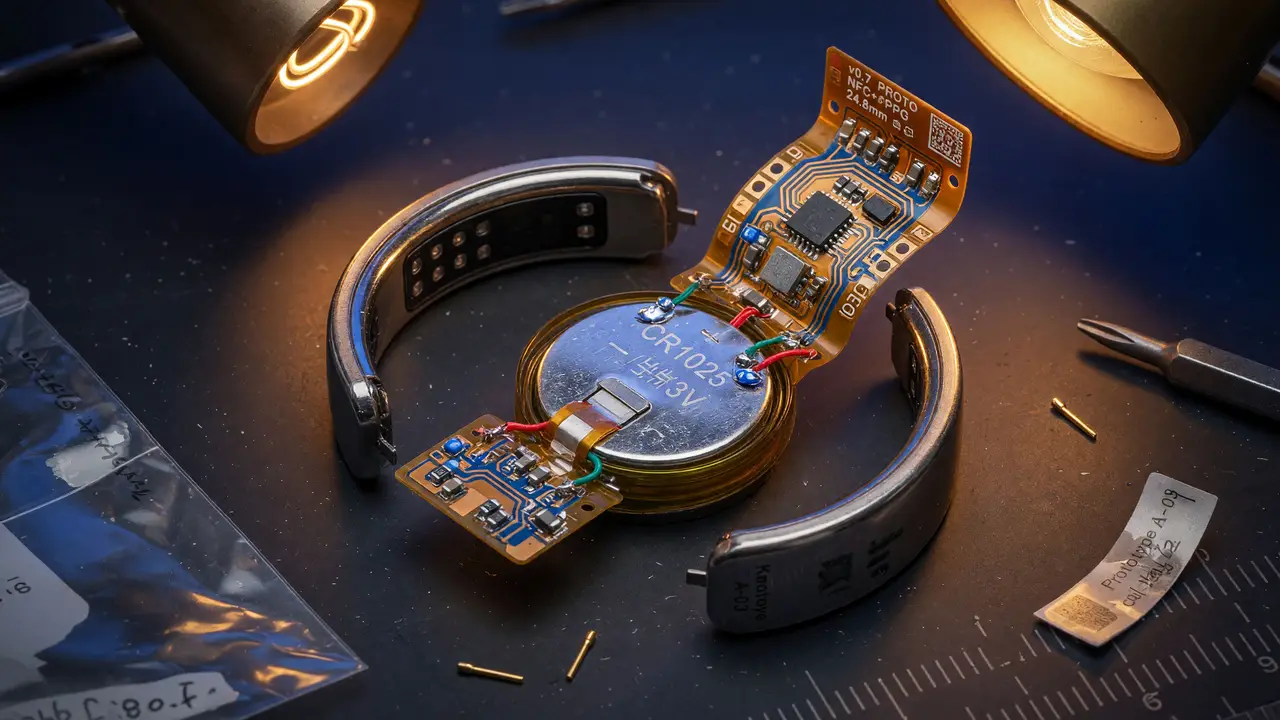
Prototyping a Custom Smart Ring: The Challenges of Flexible PCBs and Tiny Batteries
Explore the challenges of building custom smart ring prototypes, focusing on curved batteries, flexible PCBs, power budgets, and fabrication tips for makers.
Smart ring prototypes tend to fail for a simple reason: a 15–25 mAh cell has to live inside a curved 2.5 mm housing, and the two don’t play well together. Makers chasing multi-day runtime run into the same pair of problems every time—finding a flexible cell that can handle repeated insertion and removal, and routing a flex circuit whose bend radius won’t crack traces after a few weeks on a finger.
Battery Capacity Limits in Sub-30 mm Rings
Commercial rings give you the baseline. The Oura Ring Gen3 uses size-dependent LiPo cells that range from 15 mAh (US size 6) up to 22.5 mAh on larger sizes, which translates to roughly 4–7 days of real-world use with SpO2 turned on. Ultrahuman’s Ring Air keeps capacity fixed at 24 mAh across all sizes while holding total thickness between 2.45 mm and 2.8 mm.
Those numbers set the daily budget. A 20 mAh cell, after self-discharge and charging losses, has to deliver about 3–4 mAh per day if you want five days of runtime. Continuous optical heart-rate sensing plus periodic BLE advertising burns through that allowance fast unless the firmware aggressively duty-cycles the radios.
Commercially Available Curved Cells
A handful of Chinese suppliers now offer cells shaped specifically for rings. Here are the most commonly referenced options:
| Model | Dimensions | Capacity | Notes |
|---|---|---|---|
| Grepow/Mastang 150732 | 1.5 × 7 × 30 mm | 20–22 mAh | 3.7 V nominal |
| 160630 | Similar footprint | ~20 mAh | Slight shape variation |
| 160614 | Similar footprint | ~20 mAh | Slight shape variation |
| LP201020 | 2 × 10 × 20 mm | 22 mAh | Standard pouch |
| LP221220 | 2.2 × 12 × 20 mm | 25 mAh | Slightly thicker |
MOQ usually starts at 50–100 pieces, with unit pricing between $1.80 and $2.50. These cells are rated for static curvature once installed; dynamic flex life data is rarely published. Ask for cycle-life numbers at your target bend radius before you commit to a layout.
Flexible PCB Stack-up Choices
Single-layer adhesiveless polyimide can be as thin as 0.05 mm, but most wearable boards land in the 0.10–0.15 mm range once you add coverlay. IPC-2223 guidelines call for a minimum static bend radius of 3–6× thickness on single-layer boards—roughly 0.3–0.9 mm for a 0.15 mm stack. Double-layer boards push the safe radius to 6–12× thickness and add noticeable stiffness inside a 2.5 mm ring.
Rolled-annealed copper holds up better than electrodeposited copper when any repeated flexing is involved. Most ring designs stay at one or two layers with an ENIG finish. Four-layer (or higher) stacks are possible, but the minimum bend radius quickly exceeds what fits comfortably inside current ring housings.
Prototype Fabrication Economics
JLCPCB starts flexible PCBs at about $2 for five pieces in 1–2 layer configurations, with 5–6 day lead times. PCBWay offers similar pricing and supports small feature sizes down to roughly 2 mm. Neither vendor charges extra for diameters under 30 mm, so a first spin usually lands under $50 including shipping.
Stiffeners, EMI shielding, and custom cutouts raise the price but remain optional for initial validation. The low MOQ makes it practical to iterate the flex outline a few times before you lock the battery cavity geometry.
Power Budget and Runtime Validation
Published ring data shows baseline idle draw around 1.2 mAh per day. That climbs to 1.8–4.9 mAh once activity logging and frequent BLE sync are added. Hitting the five-day target therefore requires either aggressive sensor duty-cycling or acceptance of a larger cell that forces a thicker ring.
A practical approach is to measure your own sensor and radio current draws on the bench, then model daily consumption against the 15–24 mAh cells listed earlier. Only after that calculation does it make sense to move on to the mechanical layout.
To check firmware settings before ordering boards, run a quick config validation:
nrfutil device list
nrfutil pkg generate --hw-version 52 --sd-req 0x00 --application app.hex --application-version 1 firmware.zip
Custom smart-ring development is now mechanically realistic at prototype volumes. The core limit hasn’t changed, though: every extra milliamp-hour of capacity still trades directly against ring thinness and day-to-day comfort.