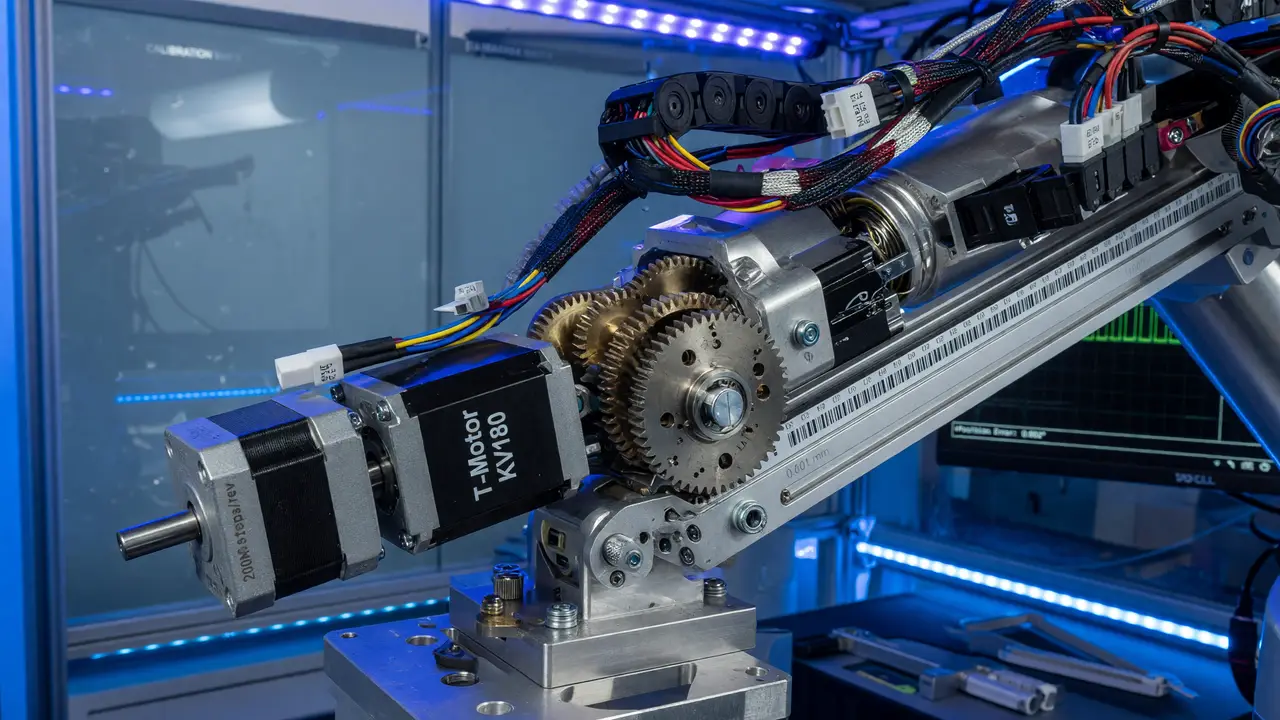
Stepper Motors vs Brushless DC (BLDC) Motors: Which Is Best for High-Precision Robotic Arms?
Compare stepper motors and BLDC servos for robotic arms on precision, efficiency, cost and real-world use in commercial systems like UR5e and Panda.
High-precision robotic arms demand sub-degree joint accuracy even as loads shift. The choice of motor often determines whether a design maintains ±0.03 mm repeatability or begins to drift after a few hours of operation.
Angular Precision and Repeatability
Stepper motors deliver reliable open-loop performance at low cost. A good NEMA 23 or 34 hybrid with 1.8° steps reaches ±0.02–0.05° repeatability when microstepped at 1/8 or 1/16. Full-revolution accuracy typically stays within ±0.05–0.09° because the errors do not accumulate. Beyond 1/32 microstepping, torque per step falls off sharply and magnetic backlash appears under load.
BLDC servo systems with 20-bit absolute encoders operate on another scale. Each count equals about 1.236 arcsec (0.000343°). Real-world closed-loop repeatability reaches ±5–10 arcsec when paired with harmonic drives and secondary output encoders—roughly 10–20× finer than microstepped steppers—and the accuracy holds as payload changes.
Comparison of typical joint-level repeatability
| Motor Type | Encoder Resolution | Repeatability | Notes |
|---|---|---|---|
| NEMA 34 Stepper (open-loop) | 1/16 microstep | ±0.02–0.05° | Drops under overload |
| Closed-loop Stepper | 1/256 microstep + encoder | ±0.01–0.03° | Added cost, still limited torque |
| BLDC Servo + Harmonic Drive | 20-bit absolute | ±5–10 arcsec | Maintains accuracy at speed |
Efficiency, Heat, and Motion Smoothness
Steppers run constant current whether loaded or not. Even sitting still they produce noticeable heat and typically run at 65–70 % efficiency. Resonance between 50–200 Hz also caps usable speed around 600–1000 RPM before torque drops.
BLDC motors under field-oriented control draw current only as needed and reach 85–92 % efficiency. Torque ripple falls below 2 %, removing the low-speed vibration common with microstepped steppers. On 24/7 collaborative arms this means smaller heatsinks and cooler enclosures overall.
Cost at the 5–10 Nm Range
Price still favors steppers on paper. A complete NEMA 34 stepper and driver runs $100–300. A comparable BLDC servo package with 17–20-bit encoders starts at $220–400 and climbs to $600–800 for EtherCAT absolute-encoder versions.
The difference shrinks once you factor in thermal management, power-supply sizing, and lost time from missed steps. Many builders therefore use steppers for low-duty prototypes and switch to BLDC when payload or runtime increases.
What Commercial Arms Actually Use
Every major high-precision collaborative arm uses brushless servo motors:
- Universal Robots UR5e — Brushless AC synchronous motors, dual Renishaw encoders, harmonic drives; pose repeatability ±0.03 mm.
- Franka Emika Panda — Frameless BLDC servos with 17–20+ bit encoders and integrated torque sensing.
- ABB GoFa CRB 15000 — BLDC actuators delivering 0.02 mm repeatability.
No commercial platform in this class uses open-loop or closed-loop steppers at the joints.
Decision Framework
flowchart TD
    A[Payload > 3 kg or 24/7 duty?] -->|Yes| B[Choose BLDC servo]
    A -->|No| C[Speed > 1000 RPM required?]
    C -->|Yes| B
    C -->|No| D[Budget < $150 per joint?]
    D -->|Yes| E[Closed-loop stepper acceptable]
    D -->|No| B
    E --> F[Add secondary encoder if accuracy drifts]
Practical takeaways
- Start with closed-loop steppers only when payload stays under 3 kg and duty cycle is intermittent.
- Move to 20-bit BLDC servos once you need better than ±0.05° sustained accuracy or continuous operation.
- Always budget for harmonic drives; gearbox backlash dominates motor resolution in either architecture.
Lab tests and field data point to the same conclusion: BLDC servo packages provide the precision, thermal headroom, and speed range needed for production robotic arms. Steppers remain a practical choice only for lower-spec or prototype systems.