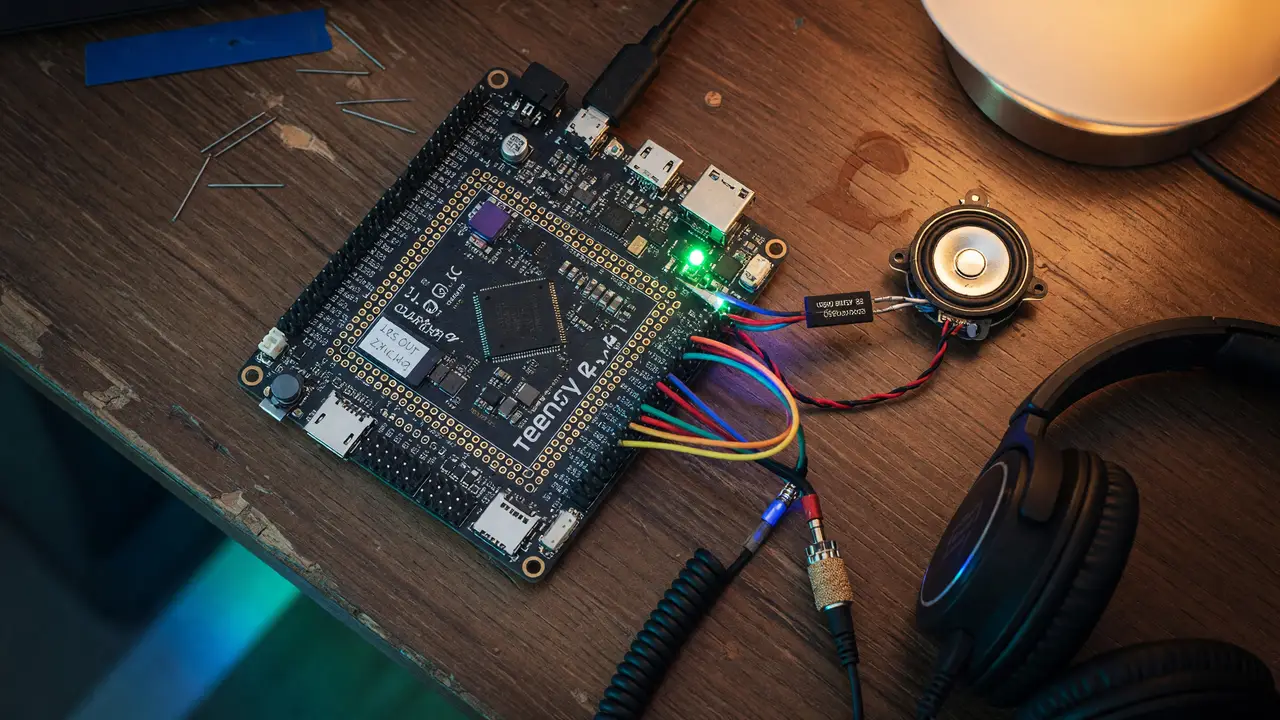
Review: Teensy 4.1 for Audio Projects
Review of the Teensy 4.1 board for low-latency multi-channel audio projects, covering its Cortex-M7 performance, I²S/TDM interfaces, USB Audio support, and comparisons.
Can a compact $30 board deliver low-latency, multi-channel audio without dedicated DSP chips? The Teensy 4.1 gets close. Its 600 MHz Cortex-M7 and mature audio library already power plenty of USB interfaces, synthesizers, and TDM mic arrays in the wild.
Hardware at the Core
The NXP i.MX RT1062 sits at the center, running at 600 MHz with both single- and double-precision floating-point units. 512 KB of tightly coupled memory provides single-cycle access for critical DSP routines, while the remaining 512 KB of SRAM and 8 MB of QSPI flash handle buffers and larger code.
Power draw sits around 100 mA at full speed. The board supports dynamic clock scaling and includes a dedicated On/Off pin for complete shutdown. The onboard MQS 16-bit Class-D output works for quick tests, but most projects rely on the two I²S/TDM ports and the S/PDIF transmitter instead.
Audio Interfaces and Measured Latency
Two I²S/TDM buses support up to 16 channels of TDM or eight channels of I²S, with simultaneous transmit and receive. The stock Teensy Audio Library uses 128-sample buffers at 44.1 kHz, delivering roughly 2.9 ms of USB round-trip latency before the codec adds its own delay. Community patches can trim I²S pipelines down to three samples—about 31 µs—at 96 kHz.
USB Audio Class 2 support over the high-speed (480 Mbps) port enables 2–8 channel, 16/24-bit streams at 48 kHz or 96 kHz when paired with the alex6679/teensy-4-usbAudio code. Users report stable eight-in/eight-out operation alongside TDM microphone arrays, as long as clocks are configured properly.
flowchart LR
    USB[USB Audio Input] -->|UAC2| Library[Teensy Audio Library]
    Library --> DSP[DSP / Effects]
    DSP --> I2S[I²S / TDM Output]
    I2S --> Codec[External Codec]
Software Ecosystem Advantages
The official Audio Library hides most DMA, buffering, and codec setup behind simple objects. Common I²S codecs like the PCM5102 or Cirrus Logic TDM parts usually need only a few lines of code. Real-time effects, polyphonic synths, and USB audio interfaces appear regularly on the PJRC forum and GitHub.
#include <Audio.h>
AudioInputUSB            usb_in;
AudioOutputI2S           i2s_out;
AudioConnection          patchCord1(usb_in, 0, i2s_out, 0);
Native double-precision floating point also means you can skip the fixed-point workarounds that other Cortex-M7 boards often require.
Competitor Comparison
| Board | Core / Speed | Audio Channels (native) | USB Audio | Double-Precision FPU | Approx. Price | Notes |
|---|---|---|---|---|---|---|
| Teensy 4.1 | Cortex-M7 600 MHz | 8 I²S / 16 TDM | HS + UAC2 extensions | Yes | $29.95–$31.50 | Mature library |
| ESP32-S3 | Dual LX7 240 MHz | 2 I²S | Device only | No | $10–$25 | Wi-Fi/BLE included |
| STM32H7 (typical) | Cortex-M7 480–550 MHz | 4–6 I²S | Custom | Yes | $30–$80 | Steeper toolchain |
The Teensy stands out because of its channel count, the USB audio extensions, and the ready-to-use library rather than raw clock speed alone.
Practical Takeaways for Builders
- Begin with the stock Audio Library for straightforward 44.1 kHz stereo work; switch to the community UAC2 objects only when you need more channels or higher sample rates.
- Pair the board with a low-jitter I²S codec and keep traces short to stay under 3 ms of latency.
- Use the microSD socket and Ethernet pads for multi-track recording or network streaming.
- Watch temperatures during sustained 96 kHz DSP loads; passive cooling is usually enough.
Conclusion
The Teensy 4.1 brings 600 MHz DSP performance, flexible I²S/TDM hardware, and a well-proven audio library at a price that undercuts most dedicated DSP modules. For engineers building USB audio interfaces, multi-channel effects, or embedded synthesizers, it remains one of the more practical choices available.