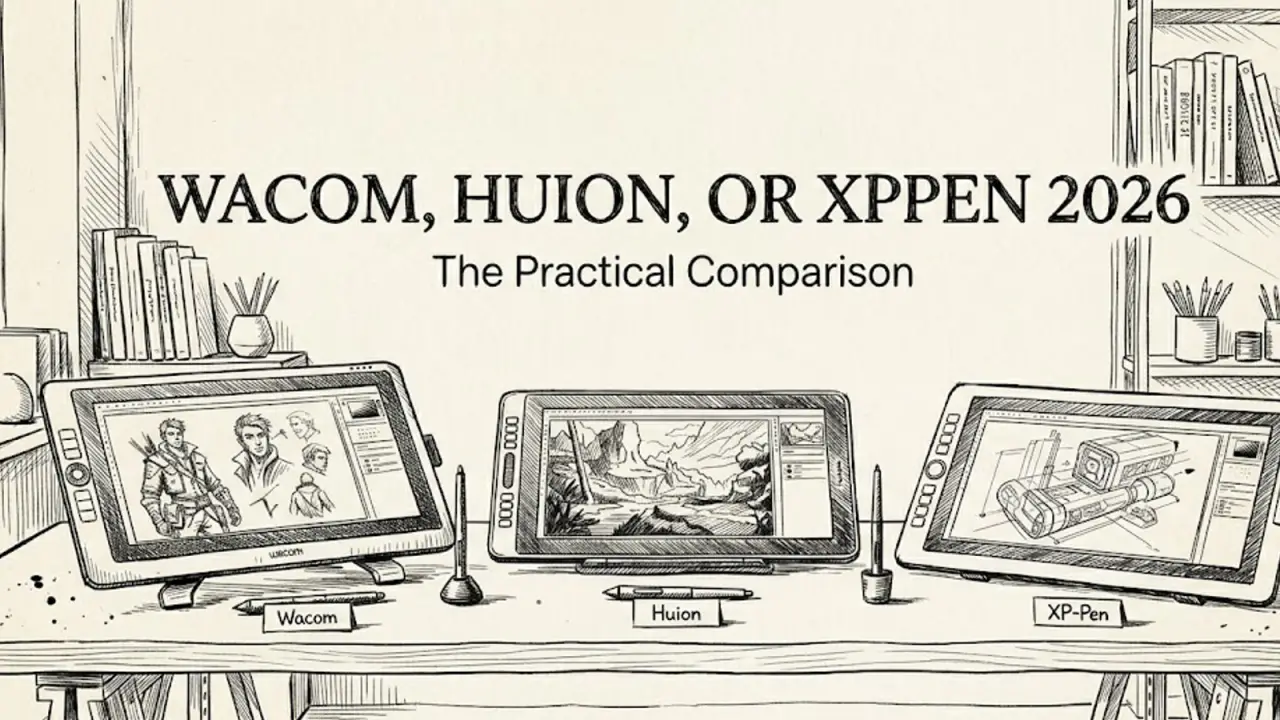
Wacom, Huion or XPen 2025
A practical comparison of Wacom, Huion, and XPPen drawing tablets in 2025.
The Digital Canvas Conundrum
You’re not buying a tablet; you’re buying a tool that will be your daily companion for hours on end. If you’ve got the budget, it’s time to stop worrying about “good enough” and start thinking about what actually works for you.
The Lineup: Head-to-Head
1. Wacom Intuos Pro (2025)
If you’re working in a professional production environment where downtime isn’t an option, Wacom is still the safest bet. Their drivers are enterprise-grade, meaning they’ll work seamlessly across multiple operating systems and screens without any sudden disconnects.
- Which size? The Large variant is perfect for drawing from the shoulder, while the Medium variant is ideal for most desks. If you’re short on space, the Small variant is great for photo editors or compact setups.
2. Wacom Movink 13
If you want Wacom’s legendary pen tracking but hate being tied to a massive desktop setup, the Movink 13 is worth considering. Its OLED display is ultra-responsive and feels like actual ink flowing directly out of the physical nib.
3. Huion Kamvas Pro 16 (2.5K)
Huion has finally shaken off its “budget alternative” label with this model. It offers a gorgeous balance of crisp screen size, great color accuracy, and responsive pen tracking without breaking the bank.
4. Huion Kamvas Pro 24 (Gen 3)
When you need a primary creative workstation, this is the heavyweight to look at. Huion engineered this massive 24-inch 4K screen specifically for traditional painters, illustrators, and print designers who require serious color depth.
5. XPPen Artist Pro 16 (Gen 2)
XPPen consistently beats everyone else to the punch with high-spec features at an aggressive price point. Their Artist Pro 16 boasts 16K pressure sensitivity via their X3 Pro smart-chip stylus, giving it a remarkably fast and tactile bite.
6. XPPen Artist Pro 24 (Gen 2) 165Hz
This thing is a massive leap forward for anyone dealing with moving images. By bringing a blazing-fast 165Hz refresh rate to a drawing display, XPPen virtually destroyed cursor lag.
7. XPPen Magic Drawing Pad
If you want an independent, mobile sketching machine but hate the slick feeling of drawing on an iPad’s glossy screen, this is your best bet. It runs on a dedicated Android operating system and features a beautifully etched, matte glass surface.
Direct Comparison: How They Handle Daily Work
When it comes down to two major pillars – software predictability and pen feel – here’s what you need to know:
| Brand | Driver Stability & OS Legacy | Primary Workflow Strength | Modular Accessories |
|---|---|---|---|
| Wacom | Excellent: Vetted for massive studio pipelines; flawless multi-display mapping and Linux support. | Best-in-class pen physics, low initial activation force, and modular pen ergonomics. | ExpressKeys built natively into screenless units; remote controllers sold separately for displays. |
| Huion | Good: Clean, modern desktop app utility; includes native hardware color calibration tools. | Unrivaled factory color precision (ΔE < 1) and pristine, anti-glare 4K panel layouts. | Includes the physical Huion Keydial Remote featuring smooth mechanical control wheels. |
| XPPen | Good: Lightweight software with incredibly fast profile swapping per creative app. | High-refresh-rate motion tracking (up to 165Hz) that completely eliminates pen trailing. | Includes the highly praised ACK05 Wireless Mini Keydial bundled directly in the box. |
Which One Should You Actually Buy?
- Go with Wacom if: You’re working in a professional production environment where downtime isn’t an option, or you simply want the most customizable, premium pen-to-paper drawing physics.
- Go with Huion if: You’re an illustrator, painter, or graphic designer whose main bottleneck is absolute color precision, and you want a large, gorgeous 2.5K or 4K workspace without paying an enterprise premium.
- Go with XPPen if: You’re an animator looking for ultra-low latency, a creator who relies heavily on dedicated hotkey remotes, or a mobile artist looking for an independent, paper-feel standalone tablet like the Magic Drawing Pad.
Product References
- Wacom Intuos Pro (2025)
- Large: https://amzn.to/4wvaURX
- Medium: https://amzn.to/49ARsJw
- Small: https://amzn.to/49yyFyw
- Wacom Movink 13 – https://amzn.to/3POssI5
- Huion Kamvas Pro 16 (2.5K) – https://amzn.to/43hIv48
- Huion Kamvas Pro 24 (Gen 3) – https://amzn.to/4uRiwfN
- XPPen Artist Pro 16 (Gen 2) – https://amzn.to/42Az7Zk
- XPPen Artist Pro 24 (Gen 2) 165Hz – https://amzn.to/49RvG4e
- XPPen Magic Drawing Pad – https://amzn.to/42Eu7my
Disclaimer: As an Amazon Associate, I earn a small commission from qualifying purchases made through these links at no extra cost to you, which directly helps support the site and fund independent hardware reviews.