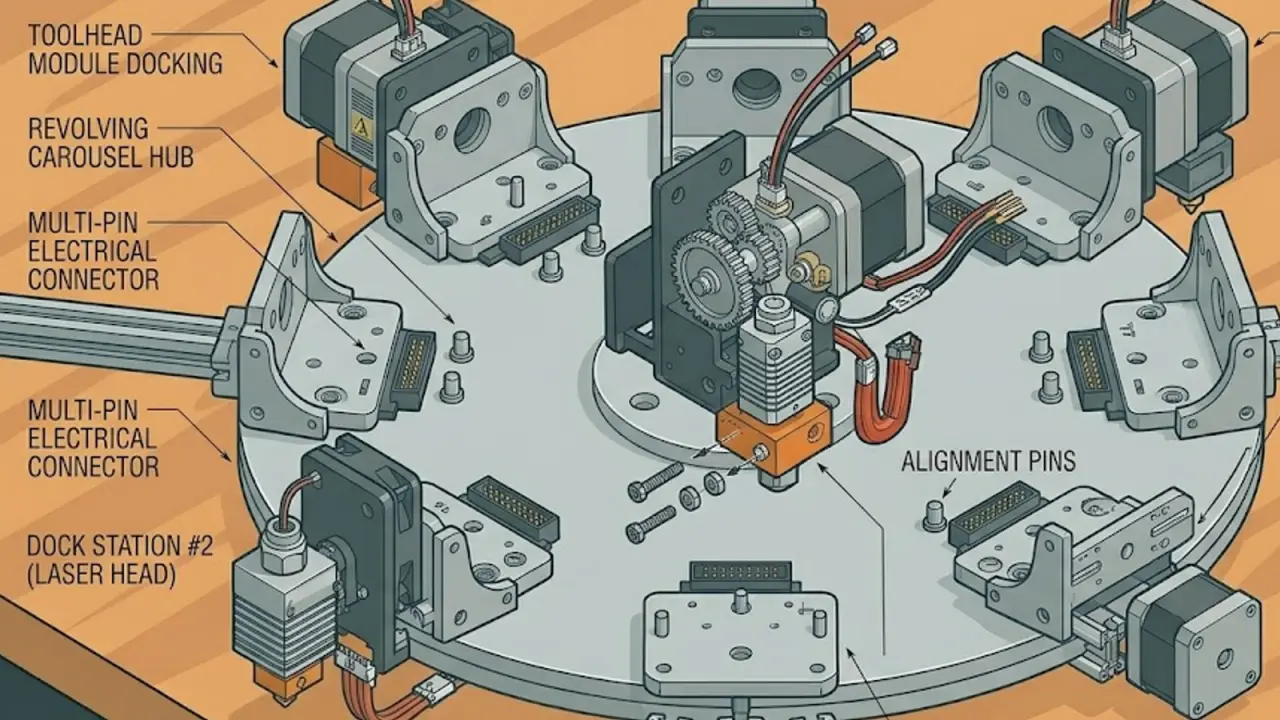
Why 2026 is the Year of the Toolchanger
High-speed printing was just the beginning. The real revolution is the death of filament waste and the rise of multi-toolhead engineering.
Speed is no longer the metric that defines a ‘pro’ 3D printer. In 2026, we have hit the physical limits of how fast a nozzle can move before the laws of thermodynamics (and plastic cooling) push back.
The real bottleneck isn’t how fast you can print one color; it is how much time and plastic you waste when you need two. For years, we have tolerated ‘poop towers’ and massive purge piles from single-nozzle AMS systems. But this year, the industry has pivoted. The Toolchanger—a system that swaps entire physical extruders instead of just retracting filament—has moved from the $10,000 industrial niche into the home workshop.
The Death of the Purge Tower
If you have used a single-nozzle multi-material system, you know the pain: for every gram of ‘Support W’ or colored filament you use, you are throwing away three grams in a purge block. It is loud, it is slow, and it is expensive.
Toolchangers like the Prusa XL or the newer Bambu Lab H-Series solve this by having dedicated heads for different materials.
- Zero Waste: There is no purging because the nozzles do not share a path.
- Material Integrity: You can print a TPU gasket directly onto a rigid Nylon frame without the temperature contamination that ruins single-nozzle hybrids.
- Redundancy: If one nozzle clogs mid-print, the system can automatically swap to a backup toolhead to save a 40-hour job.
Functional Engineering over Aesthetics
The shift toward toolchangers is driven by the demand for functional parts, not just figurines. In 2026, tinkering means building drones, wearable tech, and custom tools. These require material properties that do not play well together in a single tube.
I am now seeing builds where Tool 1 is a high-strength Carbon Fiber Nylon, Tool 2 is a water-soluble support material for complex internal geometries, and Tool 3 is a conductive filament for integrated circuitry. You simply cannot do that reliably with a single-nozzle setup without massive failure rates.
The ‘Buy Once’ Mentality
The DIY engineering community is moving away from $200 ‘starter’ printers that require $400 in upgrades. The trend is now toward ‘End-Game’ machines.
While a toolchanger has a higher upfront cost (often $2,000 to $3,500), the ROI is realized in saved filament and successful ‘impossible’ prints. We are finally at a point where the hardware is as capable as our CAD designs. If you are serious about engineering in 2026, the question isn’t ‘how fast does it print?’ but ‘how many heads does it have?’